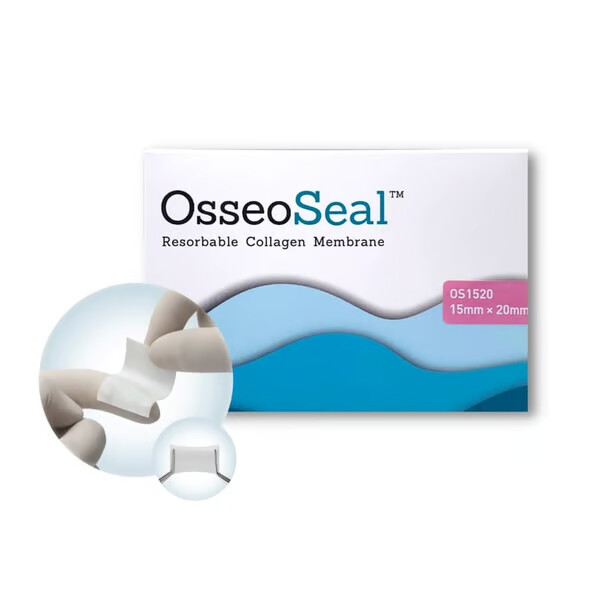
OsseoSeal (private label brand of Ossguide) is a resorbable collagen membrane derived from purified porcine pericardium. This membrane was designed to provide superior barrier function, while maintaining ideal handling characteristics. Below we have compiled and update the most frequently asked questions about the OsseoSeal Membrane so you get everything you need to know about the kit in one place. For pricing and purchasing information, please visit our shop at: OsseoSeal Resorbable Porcine Collagen Membrane
How do I place the OsseoSeal Collagen membrane, as it is very sticky?
Please refer to our placement instructions, Placement Techniques for OsseoSeal Porcine Collagen Membrane. But, a quick summary is simply that you should use a 2-instrument method when placing this membrane: dry instrument to place and anchor, and a wet instrument to hydrate and tuck. The tucking must be done with a wet instrument or OsseoSeal will stick to the instrument!
Do you have any clinical cases with the OsseoSeal Collagen Membrane?
Yes we have many clinical cases demonstrating the use of the OsseoSeal Collagen Membrane, which you can find on our community website. Here are some cases:
- Enhance GBR and Improve Implant Surgical Outcomes with Amnion-Chorion Membranes
- Aggressive Guided Bone Regeneration with DALI Grafts
- Using OsseoSeal for Buccal Contour Augmentation
What is the difference between OsseoSeal Collagen Membrane (OssGuide) and Bio-Gide?
According to the FDA 510-K submission for OssGuide, the FDA concluded that both products are substantially equivalent. The primary difference between OssGuide and Bio-Gide is that OssGuide is manufactured from Porcine pericardium, while Bio-Gide is made from Porcine peritoneum.
How should OsseoSeal Collagen Membrane (Ossguide) be secured in place?
The membrane may be secured in place with sutures, tacks, or by means of sufficient contact with the mucoperiosteal flap to avoid displacement and micro motion during healing. To facilitate proper healing, ensure that there is tension-free primary closure of the soft tissue flap covering the membrane.
What is the difference between OsseoSeal Collagen Membrane and Neomem FlexPlus?
Both OsseoSeal and Neomem Flexplus are manufactured from porcine. As such, they both offer excellent handling and adaptation to various defects. The difference is simply that Neomem Flexplus is a chemically cross-linked membrane made from porcine peritoneum, while OsseoSeal is made from purified porcine pericardium and enhanced via Dehydrothermal (DHT) treatment, which is a physical crosslinking method. There is substantial controversy surrounding chemically cross-linked vs non cross-linked membranes, and the research is conflicting. Clinicians should opt to simply choose the membrane they feel most comfortable with. You can read more about OsseoSeal here: OsseoSeal Placement