This Week we wanted to share some new research on the use of Amnion Chorion membranes in dentistry. We have shared cases in previous posts showing the use of Amnion Chorion membranes in a dual-layered membrane technique (see Aggressive Guided Bone Regeneration with DALI Grafts and Enhance GBR and Improve Implant Surgical Outcomes with Amnion-Chorion Membranes. We were therefore pleased to see a recent study which showed that early wound‑healing scores were significantly higher with amnion-chorion membranes than with a hemostatic agent (≈ 1.2‑point improvement, p = 0.027).
Quick Overview of Amnion‑chorion Membrane (ACM): Why it might Aid in Healing
The Amnion‑chorion membrane (ACM) biologic membrane taken from human placental tissue that includes the innermost amnion layer and the outer chorion layer. It is usually processed to be dehydrated, deepithelialized, or otherwise sterilized for clinical use (e.g., dHACM, ddACM). The membrane is a natural barrier that can be placed over bone grafts or surgical sites and is later resorbed by the body. ACM aids in healing because:
- There are inherent Antimicrobial, anti‑inflammatory, and angiogenic properties** to placental tissue.
- It provides a biologic barrier that protects while delivering growth factors that stimulate tissue regeneration.
Across multiple randomized, split‑mouth, and case‑series studies, amnion‑chorion membranes either improved early wound healing or were equally effective compared with established materials.
Recent Study: Use of Amnion-chorion membranes on Palatal donor‑site after soft‑tissue graft
This randomized clinical trial evaluated the use of an amnion-chorion membrane (ACM) as a palatal wound dressing following free soft tissue autograft (FSTA) harvest compared with a conventional hemostatic agent. 1 The study found that ACM significantly improved early palatal wound healing over the first 4 weeks after surgery, with higher Early Healing Index scores compared to the control group. However, notably ACM did not reduce postoperative pain or analgesic use compared with the hemostatic dressing. The findings suggest:
ACM resulted in improved early wound healing compared to HA when applied as a palatal donor site wound dressing following a FSTA harvest. Therefore, ACM may be an appropriate palatal wound dressing for patients with anticipated delayed healing. 1
Earlier Study: Palatal donor‑site compared with collagen dressing
This pilot randomized split-mouth clinical trial compared an amnion-chorion membrane (ACM) with a collagen dressing (CLD) for improving healing of palatal donor sites following free gingival graft procedures. 2 Clinical and histological outcomes, including wound closure, epithelialization, pain, tissue characteristics, and inflammatory response, were evaluated over a 60-day healing period. The study found no significant differences between ACM and CLD in any measured healing parameters. These findings suggest that ACM provides comparable healing outcomes to collagen dressings and may be considered an alternative option for managing palatal donor site wounds. 2
No significant differences in wound‑area reduction, epithelialisation, pain, or histologic parameters – ACM performed as well as collagen dressing.
Feature Case: Amnion membrane for coverage of gingival recession
This case report evaluated the use of an amnion allograft combined with a coronally advanced flap for the treatment of a localized gingival recession defect. A 32-year-old female with a 3 mm Miller Class II recession and a thin gingival biotype received root coverage surgery using an amnion membrane placed over the exposed root surface. At 6 months postoperatively, the treatment resulted in complete root coverage, improved esthetics, and increased gingival tissue thickness. 3
This study concluded:
Because of its inherent wound-modulating properties, amnion allograft may be used to enhance periodontal wound healing and enable tissue regeneration such as that in the coverage of gingival recession. Amnion allograft may provide an alternative to other conventional methods of treating gingival recession. 3
Case Images below from: Shah R, Sowmya NK, Mehta DS. [Amnion membrane for coverage of gingival recession: A novel application. 3
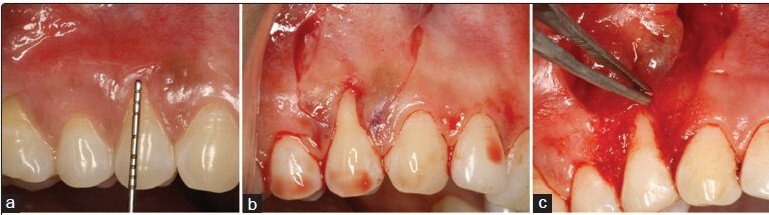
(a) Preoperative gingival recession (3 mm), (b) oblique and releasing incisions given, (c) recipient bed prepared, amnion allograft being placed.
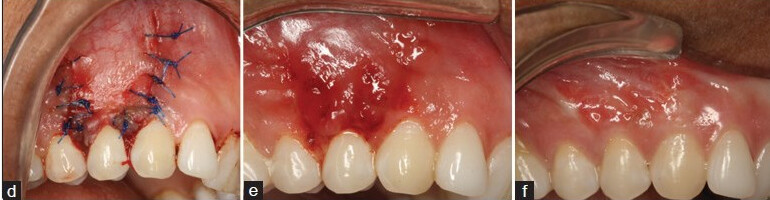
(d) flap coronally advanced and sutured, (e) healing after 10 days and (f) 6 months postoperative healing showing complete root coverage and esthetic color match
References
- Yineman KJ, Palaiologou AA, Powell CA, Deas DE, Mealey BL. Palatal donor site wound healing following mucogingival surgery using amnion-chorion membrane: A randomized controlled clinical trial. J Periodontol. 2026 Jun 18.
- Lee CT, Umoh EN, Husain A, Gomnam N, Tribble G, Wang BY, Min S. Clinical and histological outcomes of allogenic amnion-chorion membrane for palatal donor site healing. J Periodontol. 2026 Feb;97(2):188-197
- Shah R, Sowmya NK, Mehta DS. Amnion membrane for coverage of gingival recession: A novel application. Contemp Clin Dent. 2014 Jul;5(3):293-5.