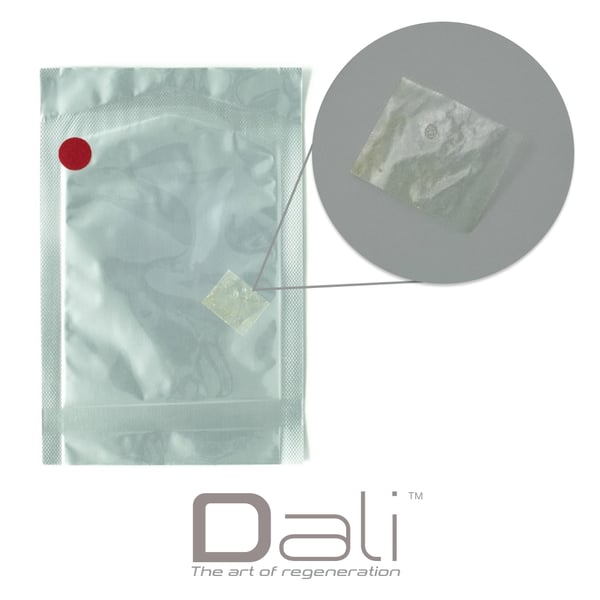
The Amnion Chorion membrane is an ideal barrier membrane for many dental applications. In this post, we compile a lot of useful information and frequently asked questions about amnion-chorion membranes. Specifically, the post refers to the the DALI ™ amnion chorion membrane, a dehydrated amniotic membrane allograft that is shelf-stable and minimally manipulated to maximize the benefits of the amniotic membrane.
What is the use case for Amnion Chorion Membranes in dentistry?
There have been many suggested applications of amnion-chorion membranes in dentistry, including gingival recession treatment, intrabony and furcation defect treatment, alveolar ridge preservation, keratinized gum width augmentation around dental implants, maxillary sinus membrane repair, and large bone defect reconstruction. (See:
Chorion and amnion/chorion membranes in oral and periodontal surgery: A systematic review. In our clinical experience, the best use case for amnion-chorion membranes is an adjunct to a regular membrane in GBR, in what is known as a the dual membrane layer technique, as more fully described in the case Enhance GBR and Improve Implant Surgical Outcomes with Amnion-Chorion Membranes
Do you have any clinical cases showing the DALI Amnion-Chorion Membrane?
Yes, please see these two cases, Enhance GBR and Improve Implant Surgical Outcomes with Amnion-Chorion Membranes and Aggressive Guided Bone Regeneration with DALI Grafts. Both cases demonstrate a unique, but highly effective way to enhance your GBR and ensure excellent surgical outcomes with the use of a DALI Amnion-Chorion membrane.
How do I place the Amnion-Chorion Membrane?
Due to the unmatched adhesion and adaptability of Amnion-Chorion membranes when hydrated, they can pose some challenges during placement, if you do not follow some basic clinical procedures. The key thing to remember is that you must use a 2-instrument method when placing this membrane: use a dry instrument (e.g. plier/forceps) to place and anchor the membrane into the site, and a wet instrument (e.g. periosteal elevator) to hydrate and tuck the membrane after placement. Using a wet instruction will prevent the membrane from sticking to the holding instrument. Actually, the placement of the amnion-chorion membrane is exactly the same as the placement of our OsseoSeal collagen membrane, please refer to Placement Techniques for OsseoSeal Porcine Collagen Membrane for some clinical photos. Finally, please note that excessive bleeding can cause amnion-chorion membranes to slide. Hemostasis should be achieved prior to placement.
What suturing techniques and suture material is recommended for use with amnion-chorion membranes?
There are many different suturing techniques and we cannot recommend one over the other. However, in socket preservation procedures, it seems as if many clinicians seem to prefer a reverse figure eight type of suture technique. The reverse technique refers to the movement of the suture needle from inside the socket to the outside. This aids in membrane retention. In terms of suture material, PTFE Suture (3.0 or 4.0) is mostly used due to the monofilament nature, which eliminates bacterial wicking. However, PTFE sutures are non-resorbable. PGCL Sutures are an absorbable monofilament suture that could also be used as an alternative to PTFE.
What is the resorption time for amnion-chorion membranes?
Amnion-chorion membranes generally resorb in 8 to 12 weeks. If the membranes are left exposed, this absorption profile will obviously differ, but given the many factors that could impact an exposed membrane, it is not possible to give a precise resorption profile for an exposed membrane. However, amnion-chorion membranes have proven to behave exceptionally well even under exposure.
Which side of the amnion-chorion membrane is placed up and which down? Is there an orientation?
No there is no orientation. The DALI amnion-chorion membrane, as well as all others we have seen in dentistry, do not have any orientation, as they are all deepithelialized. They can be placed up or down, folded, and/or layered, without any concern.
Do I need to trim Amnion-Chorion Membranes?
No. Trimming is not necessary. Amnion-chorion membranes do not need to be trimmed prior to use in most procedures. After placement, the excess membrane can be folded over itself. The membrane is safe to touch adjacent tooth/root surfaces. If trimming is required, use sharp dry scissors.
Do I need primary closure with Amnion-Chorion Membranes?
Non-Primary Closure is Acceptable with amnion-chorion membranes, so amnion-chorion membranes may be left exposed to the oral environment. When left exposed strict adherence to post-surgical protocols are necessary. See Amnion-Chorion Membrane in Open-Wound Approach for Localized Horizontal Ridge Augmentation: A Case Series
Do I need to pre-hydrate the Amnion-Chorion Membrane?
No. Pre-Hydration is not necessary. Place the membrane dry and allow it to hydrate to the site. You can also briefly hydrate the membrane prior to placement with drops of sterile saline. Note that excessive bleeding can cause amnion-chorion membranes to slide. Hemostasis should be achieved prior to placement.
What is the difference between the DALI amnion-chorion membrane and other similar membranes?
There are now several amnion-chorion membranes that are marketed in dentistry and that are each processed by highly-respected and regulated US-based Tissue Banks. In fact, many are processed by the same exact Tissue Bank and just relabeled for marketing purposes. In general, although there are slight differences in processing, all the amnion-chorion membranes are processed in a substantially similar manner, as they must be minimally manipulated according to FDA guidelines. Briefly, the membranes are deepithelialized (outermost amnion layer is removed), and the remaining amnion/chorion is dehydrated, cleansed/rinsed, sterilized and packaged.
Apparently, the main difference between some of the membranes is what layers are removed during processing (i.e. there are several underlying layers in both amnion and chorion). Some processors remove the "spongy" layer from the amnion, while others retain it (keeping it more minimally manipulated). Other processors claim to have a "thicker" membrane due to the inclusion of the Trophoblast layer part of the Chorion (the trophoblast is the innermost layer of the Chorion and the least exposed to maternal fluids).
We are not aware of any studies that compare the clinical results from the various membranes, and there is no clinical evidence whatsoever of the superiority of one brand of membrane over any other. As mentioned, all the membranes are minimally processed according to strict FDA and AATB guidelines, and all are equally effective when used with proper protocols.
In terms of the DALI amnion-chorion membrane, it is processed by Surgenex, an industry-leading allograft provider setting the standard in tissue quality and safety. The membrane is deepithelialized, as noted above.
Deepithelialized mainly refers to the outermost amnion layer that is exposed to maternal fluids, and is generally the most impacted with blood clots. In the process of removing the blood clots from the membrane, the Epithelium layer dis-attaches, thereby exposing the Basement membrane of the amnion (the first layer of collagen). Regarding the Trophoblast layer, the layer is left intact during the processing of the membranes. Additional, the tissue bank does not separate the amnion and chorion layers during processing, preserving the spongy layer, and just cleanses the tissue in order to maintain as much of the native tissue as possible. Separation of layers during processing is thought to adversely impact retention of the native growth factors.
What are some post-operative guidelines for amnion-chorion membranes?
If the membrane is exposed to the oral environment, then for 3 days post-op please instruction the patient to avoid overly aggressive rinsing, swishing with any solution to avoid dislodgement of the membrane. After 3 days, gentle rinsing with tap water is recommended for the next 7 days. The patient should not use any oral rinses 10 days post-op. This includes antiseptics; chlorhexidine (Peridex®), chlorhexidine without alcohol, and other common oral rinses. Oral rinses are can adversely impact the health of gingival cells, and chlorhexidine specifically may adversely impact the membrane. After one week the patient may begin using an oral rinse for plaque control. After 10 days post-operatively, the patient may begin using an oral rinse for plaque control.
Clinical References for Additional Information on Amnion Chorion Membranes in Dentistry
Below are some clinical references for Amnion Chorion membranes in dentistry. We will try to keep this list updated as more research is published.
-
Chorion and amnion/chorion membranes in oral and periodontal surgery: A systematic review.
-
Maxillary Sinus Membrane Repair With Amnion-Chorion Barriers: A Retrospective Case Series.