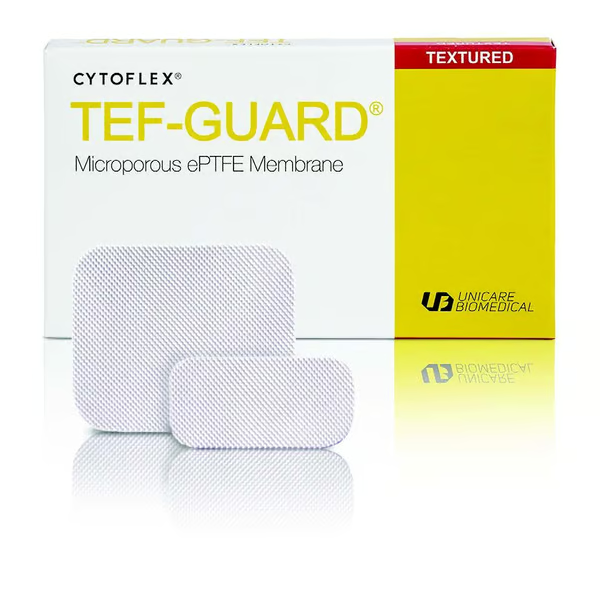
Cytoflex Textured Tefguard is a non-resorbable PTFE membrane made of a proprietary micro-porous expanded polytetrafluoroethylene (ePTFE) material, that is ideal for socket preservations and bone grafting procedures. Below we have compiled and update the most frequently asked questions about the Cytoflex Tefguard Textured microporous PTFE Membrane so you get everything you need to know in one place! For pricing and purchasing, please visit our shop at: Cytoflex Tefguard PTFE Membrane: Textured
What are Microporous PTFE membranes?
Microporous PTFE membranes (or or MP-ePTFE), such as Cytoflex Tefguard, are a next-generation PTFE material that provide all the benefits of dPTFE membranes, while also providing better handling and healing properties. As such, Microporous PTFE membranes offer the best current option for clinical cases that require a non-resorbable membrane. The micro-pores on the MP-ePTFE membranes are miniscule enough to block bacterial penetration keeping the site safe from infection, but the micro-porous material still allows nutrient permeation across the membrane enhancing healing. As such, at the discretion of the practitioner and depending on the case, the MP-ePTFE membranes, like the d-PTFE membranes, do not require primary closure. Furthermore, the texture of these materials enhances soft tissue attachment, which prevents early flap sloughing and exposure. The textured Cytoflex Tefguard also has superficial macro texture overlapping the micro pore texture on both surfaces, providing additional grips for flap attachment, and easier suture closure.
What is the difference between Cytoflex Tefguard Microporous ePTFE Membranes and High-Density PTFE Membranes (Cytoplast)?
The original PTFE membranes, popularized by the GoreTex brand, were called expanded polytetrafluoroethylene membranes, or ePTFE for short. However, these original e-PTFE membranes had some major shortcomings including, a high susceptibility to bacterial contamination, and a requirement for primary closure to prevent membrane exposure.
Dense PTFE Membranes, or d-PTFE membranes sold under the brand name Cytoplast, were developed to improve upon the original ePTFE membranes. d-PTFE Membranes were manufactured with much smaller pore sizes (<0.3 µm), which effectively blocked all bacterial infiltration. The dense structure of d-PTFE membranes helps in reducing the risk of bacterial contamination and infection, simplifies the surgical procedure reducing the need for extensive flap manipulation, and reduces the risk of d-PTFE membranes has less negative impact on clinical results compared to e-PTFE membranes. This means that even if the membrane becomes exposed, the clinical outcomes are not significantly compromised.
Despite the many significant improvements offered by d-PTFE membranes, the d-PTFE membranes still had some issues. Specifically, because of their underlying structure these membranes can have poor tissue attachment and there is a tendency for slipping and exposure of the graft material when a dPTFE membrane is used during bone augmentation procedures. Furthermore, while the tiny pore size of the dPTFE membranes block bacterial infiltration into the site, at the same time the non-porous nature of the barrier limits nutrient permeation across the membrane, which effects the ultimate healing of the site.
To address these issues with dPTFE membranes, microporous PTFE membranes, (MP-ePTFE), such as Cytoflex Tefguard, were developed. The micro-pores on the MP-ePTFE membranes are miniscule enough to block bacterial penetration keeping the site safe from infection, but the micro-porous material still allows nutrient permeation across the membrane enhancing healing. Due to the improved material, the Cytoflex Tefguard microporous PTFE membranes offer all the benefits of dPTFE membranes, while also providing better handling and healing properties. Specifically, the combination of nutrient diffusion and the micro porous texture enhances soft tissue attachment while preventing dehiscence occurrence. Furthermore, soft tissue in-growth is not significant enough with CytoFlex e-PTFE membranes, and so the material is easily retrieved. Finally, at the discretion of the practitioners, the Cytoflex Tef- Guard micro-ePTFE membranes have been used in primary coverage and non-primary coverage situation when soft tissue coverage is lacking. The membrane was designed to block off bacteria and thus exposure of the membrane, like dPTFE membranes, does not result in infection and case failure.
What about primary soft tissue coverage of the Cytoflex Tefguard membrane?
Cytoflex® Tef-Guard® membranes were designed to serve as a barrier to contain the bone graft material and prevent soft tissue and bacteria in-growth. At the discretion of the practitioners, the barriers have been used in primary coverage and non-primary coverage situations when soft tissue coverage is lacking. The membrane was designed to block off bacteria and thus exposure of the membrane does not result in infection and case failure.
How long can the Cytoflex Tefguard membrane stay in place?
In general within three to four weeks the membrane will need to be removed. This will allow enough time for the osseous tissue to begin forming and to be able to resist soft tissue from invading the graft site. However, at the discretion of the clinician, primary closure and longer healing times may be considered, if desirable.
How does you remove the Cytoflex Tefguard membranes?
Under primary coverage condition, Cytoflex® Tef-Guard® membrane may be easily removed by creating a small incision in its proximity. With forceps, firmly grasp a border of the material and remove it from the tissue. Local anesthesia is normally used for this procedure. In non-primary coverage situation, the membrane may be removed by grasping with forceps and removing it with a gentle tug. After membrane removal, re-epithelialization will occur within two to three weeks to complete the healing process. Final bone maturation will take place for six to twelve months from the time of implantation. This time frame should be considered in treatment planning cases involving heavy prosthetic loading of regenerated bone.
What is the benefit of the Textured surface on the Cytoflex Tefguard Textured membrane?
Please note that we no longer offer the Smooth Cytoflex membrane. However, the explanation below is still relevant as it provides a good explanation of the benefits of the textured Cytoflex surface.
Both Cytoflex® Tef-Guard® membranes, Textured and Smooth are composed of a proprietary micro-porous polytetrafluoroethylene (ePTFE) thin film. It has a surface texture and porosity suitable for adhesion of host cells to the material while preventing passage and integration of bacteria within the interstices of the material. The supple membrane conforms easily to tissue contours, and yet offers sufficient stiffness to maintain a space over the bony defect. The micro porous surface is designed to improve flap attachment but prevent tissue and bacteria ingrowth.
The Textured Cytoflex membranes provide a visible macro-texture similar to the configuration of strawberry fields, as opposed to the conventional pot-hole design of other barrier products. Due to this macro-texture, the handling property of the textured membrane is excellent. In addition, some clinicians find that the textured membrane is more durable and that it is easier to trim. The properties of the textured membrane allow it to withstand the pressures tucking the membrane in below the gingiva. The texture was designed to further enhance soft tissue attachment and minimize dehiscence over the grafting site.
What are the advantages for having the texture on both sides of the Cytoflex ePTFE Membrane?
There are three significant advantages for having the texture on both sides of the ePTFE Membrane:
- You don’t have to worry about which side you are trimming! All membranes need to be trimmed (sometimes, multiple times on a trial and error basis) to fit the bone grafting site. If you happen to trim on the wrong side, the membrane may not properly fit the grafting site. Having both surfaces textured prevents errors and one less thing you need to worry about.
- Eases Suture Closure! In addition, other PTFE membranes that do not have a textured surface on both sides (one side is smooth facing the bone grafting area) may tend to slide during fixation and suture closure. The extensive texture of the Cytoflex Tef-Guard facing the bone grafting site resists sliding and eases suture closure.
- More surface area to prevent dehiscence and splitting. Cytoflex Tef-Guard has significantly more texture than other PTFE membranes. Instead of individual pot holes for texture, Cytoflex Tef-Guard texture is wavy. The extensive texture provides significantly more surface area for the gum tissue to attach, to prevent dehiscence and to prevent splitting.
Can unused portions of the membrane be resterilized?
No, Cytoflex® Tef-Guard® membranes are designed for a single use only.
What is the shelf life the Cytoflex Tef-Guard membranes?
Each sterile Cytoflex Tef-Guard barrier is double packed and has 6-year of shelf life from the date of manufacture.
Have you ever had a confirmed allergic reaction to micro porous Cytoflex Tef- Guard membranes?
Cytoflex Tef-Guard membranes are made of inert and biocompatible PTFE materials. Since it was cleared by the FDA in 2002, there have not been any reported allergic reactions caused by Cytoflex Tef-Guard PTFE barrier.
Are there any contraindications to the use of the Cytoflex Tefguard PTFE membranes?
Cytoflex Tef-Guard membrane is a passive, non-load bearing material and should not be used for load bearing applications. Cytoflex Tef-Guard should not be considered for patients where general oral surgery is not advisable.
As the Cytoflex Textured Membranes are textured on both sides, which side is up, which is down, i.e. which side faces the tissue?
The Cytoflex Textured Tef-Guard PTFE membrane has the same textured surface on both sides of the membrane. It does not matter which side faces the tissue.
What is the thickness of the Cytoflex Tefguard microporous ePTFE membrane?
The thickness of this membrane is approximately 0.25mm.
Do you have any clinical cases to share for the Cytoflex Tefguard Membrane?
Yes. You can see a case in this post, Microporous PTFE Membranes for Vertical Augmentation and also in this post, Cytoflex Tefguard Case and Interview