This Week in Dental Implants we are covering a three-year follow-up study from the University of Zurich that suggests that both subepithelial connective tissue grafting (SCTG) and guided bone regeneration (GBR) can maintain stable buccal contours and healthy peri-implant tissues when treating small buccal dehiscence defects (≤3 mm). Although SCTG demonstrated an initial advantage in contour stability at one year, both approaches remained largely stable over the following two years.
Background on Buccal bone deficiencies
Buccal bone deficiencies around implants present a common challenge in implant dentistry. Guided bone regeneration (GBR) has traditionally been used to reconstruct deficient buccal bone. However, in cases involving smaller defects, soft-tissue augmentation using a subepithelial connective tissue graft (SCTG) is a potential alternative.
The rationale is that increasing soft-tissue thickness may help maintain the buccal contour and improve the stability of the peri-implant mucosal margin, even when complete reconstruction of the underlying bone is not the primary objective.
Earlier Research on GBR and SCTG
- Jung et al. (2017): In a randomized trial of small buccal dehiscence defects (≤5 mm), GBR resulted in greater buccal bone gain than spontaneous healing. However, the untreated sites also showed generally healthy peri-implant tissues, suggesting that the need for augmentation may depend on defect characteristics. (1)
- ITI Consensus (2023): A systematic review concluded that soft-tissue augmentation, including connective tissue grafting, can help maintain peri-implant mucosal thickness and soft-tissue margins over the medium and long term. This supports SCTG as an approach to improving tissue volume, although it does not establish that it can replace bone augmentation. (2)
- Zuercher et al. (2025): A separate sub-analysis of an randomized clinical trial (RCT) comparing GBR with spontaneous healing for small buccal defects found similar one-year contour and peri-implant outcomes. This adds to the question of whether every small defect requires GBR. (4)
- Ferrarotti et al. (2025): A randomized trial comparing a volume-stable collagen matrix with SCTG found comparable early soft-tissue volume gains. The collagen matrix produced more favorable patient-reported outcomes, while SCTG showed some advantages in contour stability and radiographic outcomes at one year. (5)
The Longer-Term Study: One-Year vs. Three-Year Results
Zuercher et al. (2023) conducted a randomized pilot trial comparing SCTG and GBR for small buccal dehiscence defects (≤3 mm) around dental implants. (3)
At the one-year follow-up, SCTG demonstrated a tendency toward better buccal contour stability:
- SCTG: +0.45 mm median contour change.
- GBR: −0.94 mm median contour change.
Both groups maintained healthy peri-implant tissues, although patients receiving SCTG tended to report greater postoperative discomfort.
In the newly published 2026 follow-up (6), researchers evaluated the outcomes after three years. Of the original patients, 16 completed the follow-up (SCTG: 5, GBR: 6, control: 5).
The key finding in 2026 was that both approaches maintained relatively stable buccal contours between years one and three. Peri-implant clinical parameters and marginal bone levels also remained relatively stable, with favorable patient-reported outcomes in both groups.
The findings suggest that although SCTG demonstrated an early advantage in contour stability, both SCTG and GBR can maintain favorable outcomes over the longer observation period. So both approaches appear to be reasonable options, depending on the defect, treatment objectives, and patient preferences.
This is particularly relevant when considering the additional surgical morbidity associated with SCTG. GBR avoids the need for palatal tissue harvesting, making it an attractive alternative for patients and clinicians who prefer to avoid a second surgical site.
However, it is important to note that this was a small pilot study, with only 5-6 patients per group completing the three-year follow-up. It was not powered to establish equivalence or superiority between the two approaches. Larger randomized trials are needed to confirm the findings.
Case Photos
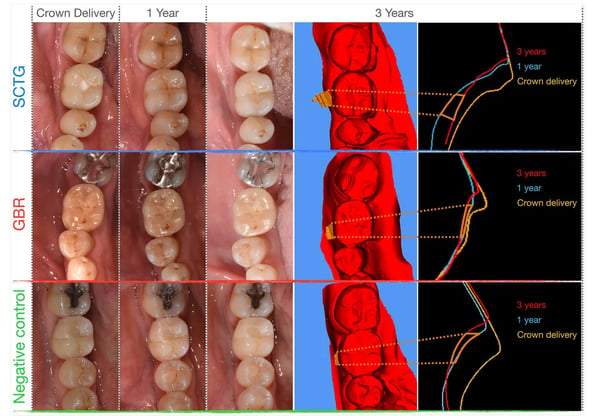
Clinical and volumetric changes in the peri‐implant soft‐tissue contour from crown delivery (baseline) to the 3‐year follow‐up, assessed at 1 mm and 3 mm apical to the mid‐facial mucosal margin. GBR, guided bone regeneration; NC, negative control; SCTG, subepithelial connective tissue graft*.*
Source: Zuercher AN, Rusch F, Strauss FJ, Jung RE, Lim HC, Thoma D. Treatment of small peri-implant buccal dehiscence defects with SCTG or GBR: 3-year results of a pilot study
Volume‐Stable Collagen Matrix or Connective Tissue Graft
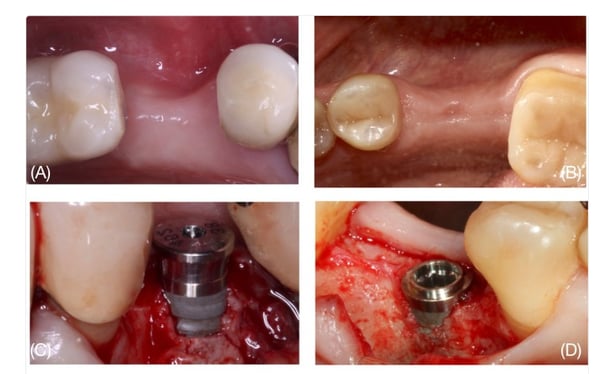
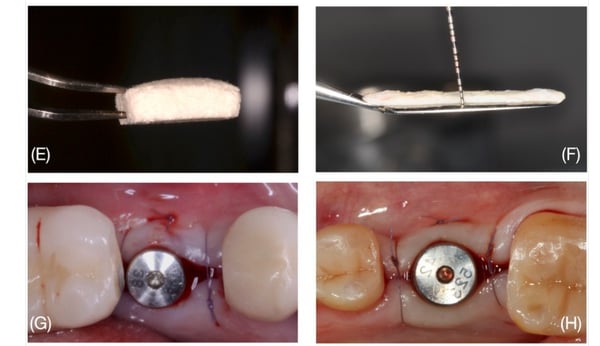
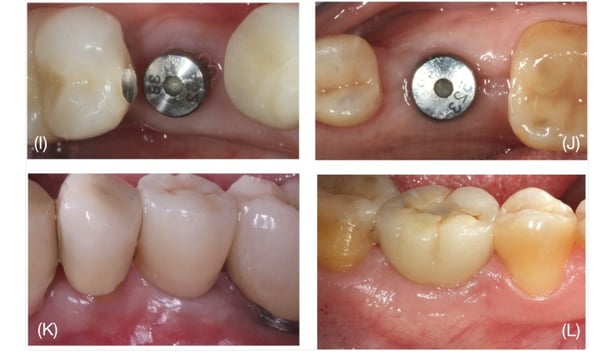
Clinical procedures represented (left: VCMX, volume‐stable collagen matrix; right: CTG, de‐epithelized connective tissue graft). (A, B) Occlusal view displaying the volume deficiency. (C, D) Intrasurgical view of small buccal bone dehiscences at the implant positioning. (E, F) VCMX and CTG harvested from the palate after trimming. (G, H) Flap stabilization with sutures and wound closure. (I, J) Occlusal view at 3 months after surgery (3 M). Clinical pictures at 1 year after prosthetic loading (K, L).
Source: Ferrarotti F, Baima G, Mohammadi G, Carboncini C, Romano F, Aimetti M. Peri-implant soft tissue increase at small buccal bone dehiscences with either volume-stable collagen matrix or connective tissue graft: a randomized controlled trial.
References
-
Jung RE, Herzog M, Wolleb K, Ramel CF, Thoma DS, Hämmerle CHF. A randomized controlled clinical trial comparing small buccal dehiscence defects around dental implants treated with guided bone regeneration or left for spontaneous healing. Clin Oral Implants Res. 2017;28(3):348-354.
-
Zuercher AN, Strauss FJ, Paqué PN, Bienz SP, Jung RE, Thoma DS. Randomized controlled pilot study comparing small buccal defects around dental implants treated with a subepithelial connective tissue graft or with guided bone regeneration. Clin Oral Implants Res. 2023;34(10):1094-1105.
-
Zuercher AN, Mühlemann S, Ruales-Carrera E, Hjerppe J, Jung RE, Thoma DS. Comparing small buccal dehiscence defects treated with or without guided bone regeneration: a sub-analysis of an RCT. Int J Periodontics Restorative Dent. 2025;45(6):772-783.
-
Ferrarotti F, Baima G, Mohammadi G, Carboncini C, Romano F, Aimetti M. Peri-implant soft tissue increase at small buccal bone dehiscences with either volume-stable collagen matrix or connective tissue graft: a randomized controlled trial. Clin Oral Implants Res. 2025;36(7):846-858.
-
Zuercher AN, Rusch F, Strauss FJ, Jung RE, Lim HC, Thoma D. Treatment of small peri-implant buccal dehiscence defects with SCTG or GBR: 3-year results of a pilot study. Clin Implant Dent Relat Res. 2026;28(6):e70192.