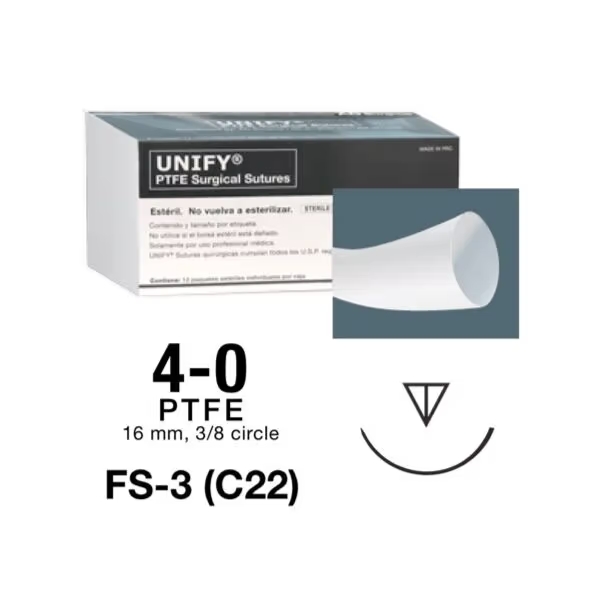
PTFE sutures are popular for dental implant and bone grafting procedures. If you have any questions about the PTFE Suture, please review our frequently asked questions below. For pricing and purchasing options, please see our PTFE Suture at Non-Absorbable Sutures.
What are the advantages of PTFE sutures in implant dentistry?
PTFE Sutures offer the best of both worlds of monofilament and braided sutures. They offer the soft tissue response and elimination of bacterial wicking characteristics usually associated with a monofilament, while maintaining the flexibility and patient comfort usually associated with braided sutures. Additionally, they retain a high tensile strength and are readily visible in the mouth.
When are PTFE sutures most often used?
PTFE Sutures are most often used in conjunction with bone grafting, the placement of dental implants, periodontal surgery, and soft tissue grafts.
Have you ever had a confirmed allergic reaction to PTFE Sutures?
No. PTFE is inert and biocompatible.
What kind of knot do you recommend for securing PTFE sutures?
A double throw, followed by a locking stitch in the opposite direction, and then a second locking stitch in the opposite direction of the first locking stitch.
How long can the PTFE sutures be left in place?
While this is left to the discretion of the surgeon, most clinicians find that the sutures may be left in place for 2 to 4 weeks because of the biocompatibility of PTFE and the maintenance of tensile strength.
What sizes of PTFE Sutures do you sell?
We currently offer 4.0 PTFE Sutures and 3.0 PTFE Sutures.