This Week in Dental Implants we are highlighting a new study to determine whether horizontal platelet-rich fibrin bone block (H-PRF-BB) produces better outcomes than the more traditional deproteinized bovine bone matrix (DBBM) when performing transcrestal sinus floor elevation (TSFE) during dental implant placement.
What is Horizontal Platelet-rich Fibrin Bone Block (H-PRF-BB)?
Horizontal platelet-rich fibrin bone block (H-PRF-BB) simply defines a technique whereby Liquid and Solid PRF is produced via horizontal centrifugation (see: Horizontal Centrifuge for PRF) and then mixed in with Deproteinized Bovine Bone Mineral (see OsseoSeal Bovine Bone Graft) to produce a sticky bone block. Notably, while sticky bone can be created by mixing Solid PRF + Graft material alone or with Liquid PRF + Graft Material alone, studies show, as seen in the case below, that mixing both together provides the best outcome:
"Bone block made by mixing DBBM particles with Solid-PRF fragments followed by additional use of Liquid-PRF formed by far the fastest solidification results as well as the PRF bone block most resistant to degradation. " 1
Case Photos for Preparation of Platelet Rich Fibrin and a Deproteinized bovine bone mineral Bone Block
This study concluded that: “The combined use of Solid-PRF fragments and Liquid-PRF mixed with DBBM particles produced a 3D flexible, moldable sticky bone block with a short time for solidification, great mechanical strength, and ability to induce osteogenic differentiation of osteoblasts.”
(Case photos from: Feng M, Wang Y, Wei Y, Zhang X, Xiao L, Gong Z, Fujioka-Kobayashi M, Sculean A, Miron RJ, Froum S, Zhang Y. [Preparation, characterization and biological properties of a novel bone block composed of platelet rich fibrin and a deproteinized bovine bone mineral.)
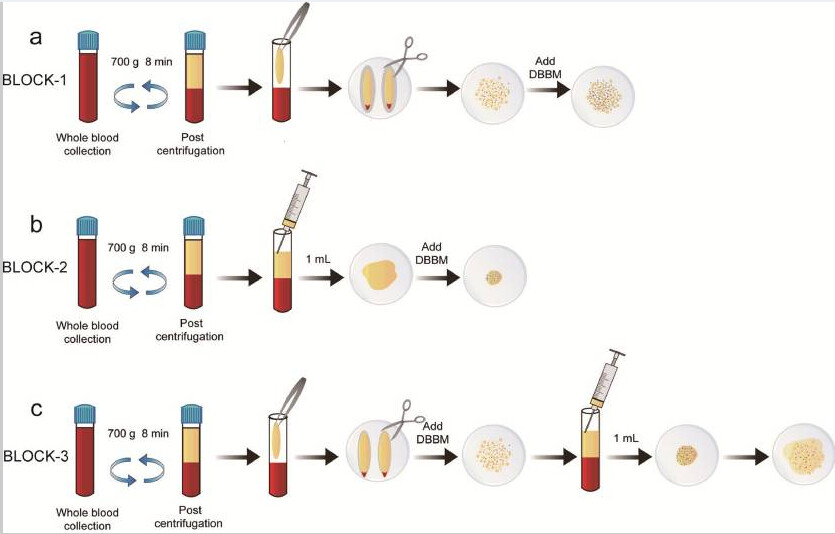
Schematic demonstrating the preparation of PRF blocks. (a) BLOCK-1 was prepared by cutting the Solid-PRF membrane into fragments and mixing them with DBBM particles. (b) BLOCK-2 was prepared by mixing DBBM particles with Liquid-PRF.(c) BLOCK-3 was prepared by mixing DBBM particles with Solid-PRF fragments followed by addition of Liquid-PRF.
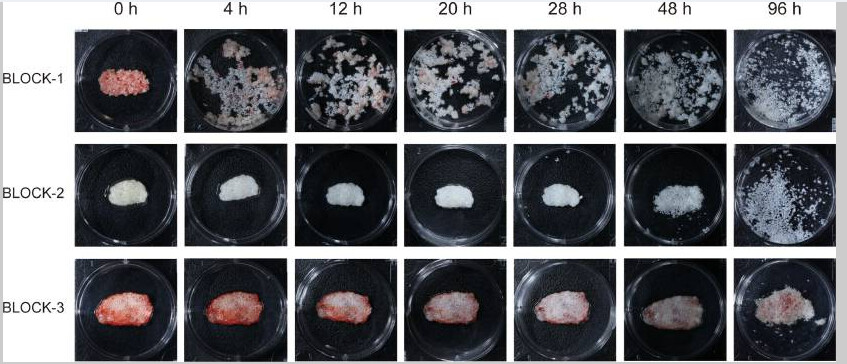
Photographic time profile of PRF blocks demonstrating their ability to maintain their shape over time (Samples were performed in triplicate) .
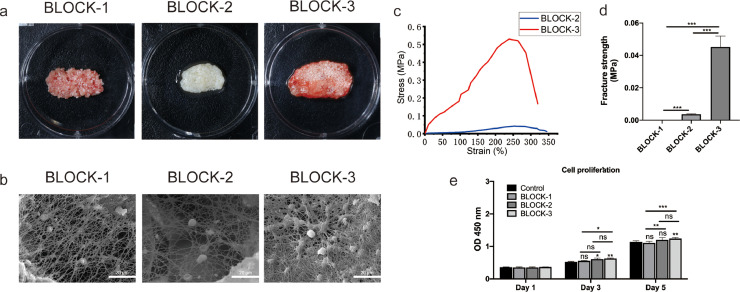
Characteristics of PRF blocks . (a) Photos of BLOCK-1, BLOCK-2, BLOCK-3. (b) SEM image of BLOCK-1, BLOCK-2, BLOCK-3, scale bar = 20 μm. (c, d) The tensile resistance and fracture strength of BLOCK-1, BLOCK-2, and BLOCK-3 (Samples were performed in triplicate). (e) Proliferation assay of osteoblasts at day 1, 3 and 5 using control culture medium and conditioned culture medium from all three PRF blocks (* denotes P<0.05, ** denotes P<0.01, *** denotes P<0.001; Samples were performed in triplicate with 3 independent experiments).
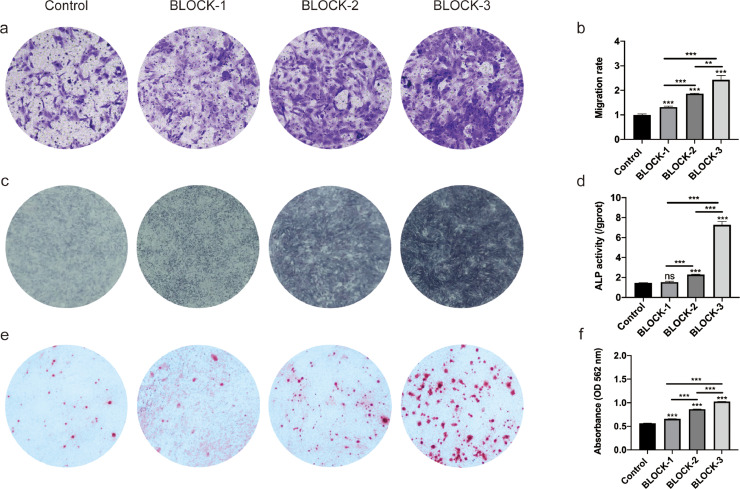
Osteoblast migration and differentiation assays . (a) Light microscopic images of osteoblast migration using a Transwell assay at 24 hours cultured with the normal culture medium or conditioned medium from all three PRF block groups. (b) Quantitative analysis of osteoblasts migrated in (a) (** denotes p <0.01, *** denotes p <0.001; Samples were performed in triplicate with 3 independent experiments). (c, d) Light microscopic image and quantitative analysis of ALP activity representative of osteoblast differentiation at day 7 (** denotes p <0.01, *** denotes p <0.001; Samples were performed in triplicate with 3 independent experiments). (e, f) Light microscopic image and quantitative analysis of mineralization nodules formed at 14 days by osteoblasts using Alizarin Red Staining (*** denotes p <0.001; Samples were repeated 3 times independently).
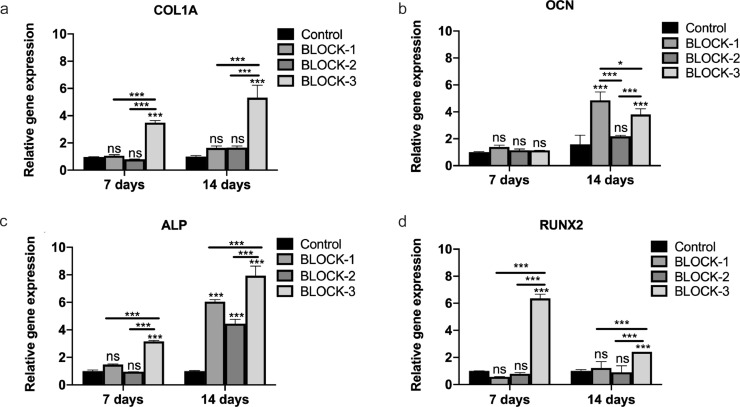
The expression of osteoblast differentiation markers induced by PRF blocks . The mRNA expression of COL1A (a), OCN (b), ALP (c), RUNX 2(d) of osteoblasts at day 7 and day 14 using the normal culture medium or conditioned medium from all three PRF block groups (*** denotes p <0.001; Samples were repeated 3 times independently).
Recent Study H-PRF Bone Block
Is H-PRF Bone Block As Effective when compared to DBBM in Transcrestal Sinus Floor Elevation? 2
The primary intent of this study was to determine whether a newer grafting material/technique—horizontal platelet-rich fibrin bone block (H-PRF-BB)—produces better outcomes than the more traditional deproteinized bovine bone matrix (DBBM) when performing transcrestal sinus floor elevation (TSFE) during dental implant placement.
What they measured
Using CBCT scans, they compared:
- How much bone height was gained after the sinus lift.
- How much of that gained bone remained over time.
- How much bone stayed above the implant tip (apex).
- Whether the implant apex became exposed as healing progressed.
What they found
Although many measurements were not statistically significant, the overall trend favored H-PRF-BB:
- More bone height was maintained at follow-up.
- Less shrinkage (resorption) of the augmented bone occurred over time.
- More bone remained covering the implant apex.
- Fewer implants had exposed apices during follow-up.
Practical takeaway
The study’s authors were essentially testing whether H-PRF-BB could be a superior alternative to DBBM for sinus augmentation. Their conclusion was that:
H-PRF-BB showed better radiographic outcomes in TSFE compared to DBBM, with an elevated EH2 and AH2. The use of H-PRF-BB was found to reduce the height decrease over time and lessen implant exposure at the apex.
A key caveat is that this was a retrospective study with a relatively small sample size, and several outcome differences did not reach statistical significance. Therefore, the results suggest a potential advantage for H-PRF-BB, but they do not definitively prove it is superior. A prospective randomized clinical trial would provide stronger evidence.
References
- Feng M, Wang Y, Wei Y, Zhang X, Xiao L, Gong Z, Fujioka-Kobayashi M, Sculean A, Miron RJ, Froum S, Zhang Y. Preparation, characterization and biological properties of a novel bone block composed of platelet rich fibrin and a deproteinized bovine bone mineral. Fundam Res. 2021 Aug 22;2(2):321-328.
- Xia T, Zeng H, Li Y, Zhang X, Wang Y, Miron RJ, Yu S, Qiu Y, Zhang Y. Efficacy of H-PRF Bone Block Versus DBBM in Transcrestal Sinus Floor Elevation: A Retrospective Cohort Study. Clin Implant Dent Relat Res. 2026 Jun;28(3):e70161.