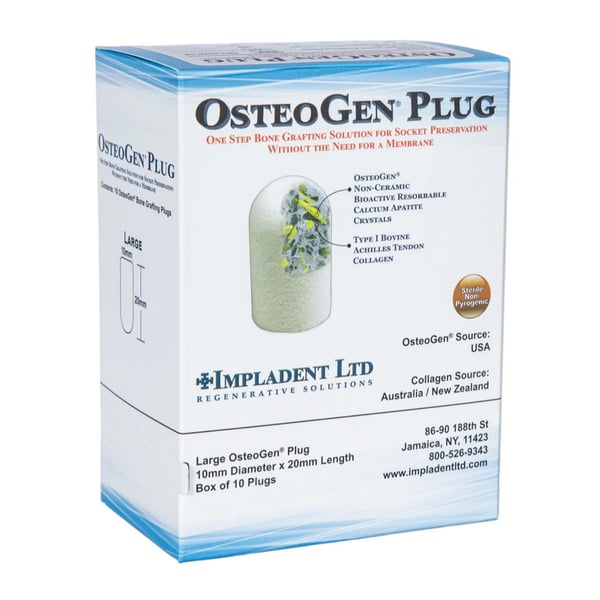
The OsteoGen Plug combines synthetic bone graft (Osteogen crystals) with a collagen plug to yield and affordable way to clinically deliver bone graft for socket preservation! Below we have compiled and update the most frequently asked questions about the Osteogen Plugs so you get everything you need to know about Osteogen Plugs in one place! For pricing and purchasing, please visit our shop at: OsteoGen Bone Grafting Plug
Do we need to use a membrane with the Osteogen Plug if there is no buccal plate? If so, what kind of membrane?
The OsteoGen Plug was designed to be used in sockets with four walls. If the buccal plate is missing, it is likely that a membrane will be required. A sustained resorption membrane (4-6 months resorption time) should be sufficient in this situation.
Can we cut the large Osteogen plug and use it for smaller sockets?
Yes, the OsteoGen Plug can be easily cut for smaller sockets After it is cut, the clinician can roll it between his/her fingers, if additional contouring is necessary. Additionally, the plug can be moistened slightly for easier shaping.
Do you need primary closure when using the Osteogen Plug?
Assuming the proper situation (read more below), no primary closure is necessary when grafting extraction sites with the Osteogen Plugs. This is the biggest benefit of the Osteogen plug – no membrane required when grafting extraction sites. However, it is very important to remember that: The OsteoGen Plug was designed to be used in sockets with four walls. If the buccal plate is missing, it is likely that a membrane will be required. The most commonly used socket preservation technique is the “mineralized bone plug” technique made popular by Hom Lay Wang (although there are a dozens of similar techniques). The basic premise is that you fill the site with graft and cover with a collagen plug. With the OsteoGen Plug, it’s the graft and plug in one, so just put the plug into place and suture over top.
Is the Osteogen Plug entirely different from Foundation from J Morita?
Osteogen Plugs are very different than Foundation. Foundation is composed ONLY of atelo-collagen. There is no actual graft material in Foundation. Osteogen Plugs, however, is highly purified Type I bovine Achilles tendon collagen, combined with crystals of the product OsteoGen, a synthetic bioactive resorbable graft of the non-ceramic hydroxylapatite category. Osteogen has been used as a synthetic bone graft material for nearly 30 years. It is the combination of a proven synthetic bone graft material with a collagen plug that makes Osteogen Plugs unique.
What is the Osteogen Plug made from?
Osteogen plugs are a standard collagen plug infused with Osteogen bone graft. It’s a unique combination of OsteoGen ® Bioactive Resorbable Calcium Apatite with a bovine achilles tendon collagen matrix. The combined structure mimics the organic and inorganic components of physiologic bone. The Bovine Achilles Tendon collagen carries the bone graft for easy and efficient delivery to the site, eliminating the hassle and time spent mixing and packing particulate grafts while also eliminating the potential for graft wash out. OsteoGen® is a bioactive and resorbable calcium apatite crystal bone graft that is physicochemically & crystallographically similar to human bone. The Type I collagen acts as a wound dressing not only to stabilize the clot, but also to absorb and deliver blood flow to the slowly resorbing graft, a feature critical for the initiation of bone formation and early angiogenesis. More about Osteogen OsteoGen® is a bioactive & resorbable calcium apatite crystal that is physicochemically similar to human bone. The production process yields a unique Ca:P ratio that is NOT a ß-TCP and NOT a dense ceramic HA, nor is it a biphasic mixture of the two. It has been proven safe, reliable and clinically effective for use with implants for over 30 years. The OsteoGen® bioactive & resorbable crystal clusters control migration of connective tissue and form a strong bond with newly growing bone. This intimate contact results in better bone formation for implant support. The x-ray reveals when sufficient bone has formed and the site is ready for implant placement. OsteoGen® non-ceramic crystals are radiolucent on the day of placement & radiopaque in ~4-6 months following resorption and host bone formation.
What Sizes is the Osteogen Plug Available In?
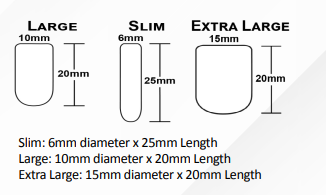
The OsteoGen Bone Grafting Plugs are available in three sizes: Large (10mm x 20mm), Slim (6mm x 25mm), and Extra Large (15mm x 20 mm) . They also come packaged in 5 per box, 10 per box, or 25 per box, with the exception of the Extra Large which is available only the 5 per box. The Large plug, which is 10mm x 20mm is actually the standard size of the classic collagen plug, and it is by far the most popular size. Please note that on DDSGadget, we currently only offer the Large or, as we call it, the Standard sized plug, as that size is indicated for virtually all clinical situations.
The specific sizes are:
Slim: 6mm diameter x 25mm Length
Large: 10mm diameter x 20mm Length
Extra Large: 15mm diameter x 20mm Length
How does the Osteogen Plug compare to other materials for Alveolar Ridge Preservation?
There are various grafting options for ridge preservation, including allografts, xenografts, and synthetic grafts, like Osteogen Plugs.
There have been a few studies comparing Osteogen Plugs to other Materials. In one study, Comparative in vitro study of commercially available products for alveolar ridge preservation (J Periodontol. 2022 Mar;93(3):403-411), the authors compared Helistat (collagen control) (Material 1), OsteoGen Plug (Material 2), Bio-Oss Collagen (Material 3), and J-Bone (native bone) (Material 4), and concluded that the Osteogen Plug demonstrated significantly better biocompatibility than the other options.
Another study, Alveolar Ridge Preservation Utilizing Composite (Bioceramics/Collagen) Graft: A Cone-Beam Computed Tomography Assessment in a Randomized Split-Mouth Controlled Trial (Journal of Biomedical Science and Engineering > Vol.14 No.2, February 2021), compared the use of Osteogen Plug in a socket vs sockets that were left to unassisted heal. It concluded that,
The use of the osteogen plug has reduced the resorption of the alveolar bone in the horizontal and vertical dimensions at 4 months post-extraction significantly compared to the normal healing of alveolar after extraction. However, it was not able to completely prevent it from occurring and was not able to achieve any increase in the dimensions of the socket.
Finally, and perhaps most importantly, there has been an actual clinical trial registered with the US Government, Clinical Evaluation Of Soft Tissue Closure In Alveolar Ridge Preservation Procedures, that aimed to compare a) standard of care, using allograft, treatment for tooth extraction and ridge augmentation procedures, or b) standard of the care treatment protocol and ridge augmentation procedures with Osteogen. Unfortunately, the final results of the study have not been posted to the ClinicalTrials.gov website, so it is still not possible to fully show what the study demonstrated.
What is the price of the Osteogen Plugs?
For an in depth review of Osteogen Plug pricing, please see: What is the price of the Osteogen Plug?