This Week in Dental Implants, we review the evidence surrounding the use of CBCT to predict primary implant stability, particularly in light of a new 2026 study that found that a combination of CBCT-derived bone density and ridge width explained approximately 50% of the variation in ISQ. 7
The findings are particularly relevant because primary stability is typically measured only after implant placement. If CBCT can provide a reliable estimate of stability before surgery, it could potentially help clinicians with implant selection, treatment planning, and decisions regarding immediate or early loading.
Introduction: What Clinical Factors are the Studies Measuring for Implant Stability?
Primary implant stability is an important prerequisite for successful osseointegration and is particularly relevant when immediate or early loading is considered. Stability is commonly evaluated at implant placement using insertion torque value (ITV) and implant stability quotient (ISQ). ITV measures the mechanical resistance encountered during implant insertion, while ISQ, obtained through resonance frequency analysis, provides an objective measure of implant–bone stability. Although related, ITV and ISQ measure different aspects of primary stability and should not be considered interchangeable.
CBCT is already routinely used before implant placement to evaluate bone volume, ridge dimensions, and anatomy. Increasingly, researchers have also investigated whether CBCT-derived bone density and structural characteristics can provide information about the stability an implant is likely to achieve.
The key question:
Can information obtained from a preoperative CBCT predict the primary stability of an implant before it is placed?
What does the previous research show for predicting Implant stability with CBCT?
Below we have summarized all the related research that we have found concerning the topic along with our brief overview.
| Study | Year | Setting | CBCT variable(s) | Stability measure | Main finding | Significance |
|---|---|---|---|---|---|---|
| Wada et al. | 2015 | Ex vivo pig ilium | Cortical thickness, voxel value | IT, ISQ | Cortical thickness correlated with IT and ISQ; voxel values correlated with IT | Early evidence that CBCT bone characteristics relate to primary stability |
| Pauwels et al. | 2017 | Ex vivo human mandibles | Trabecular structure, FD, cortical thickness, etc. | IT, ISQ | Low–moderate correlations; relationships depended strongly on measurement location | Shows that where bone is measured matters |
| Mikic et al. | 2022 | Ex vivo animal bone | CBCT bone density/HU | ISQ | Significant density–ISQ correlations in several implant/bone combinations | Supports bone density as a potential predictor, but limited by ex-vivo model |
| Feng et al. | 2023 | 22 patients / 65 implants | CBIC, bone microstructure | IT, ISQ | CBIC and microstructure correlated with IT; not baseline ISQ | Shows CBCT may predict some aspects of stability better than others |
| Shokri et al. | 2024 | 60 clinical patients | Gray value, fractal dimension | IT, ISQ | FD and GV significantly correlated with IT and ISQ | Important clinical evidence that CBCT-derived bone quality measures relate to primary stability |
| Khan et al. | 2025 | 73 patients / 118 implants | CBCT bone density (HU) | IT + implant success/failure | Strong density–torque relationship; failed implants had substantially lower density and torque | Adds clinical failure/survival relevance to the CBCT–stability relationship |
| Badawy et al. | 2026 | 35 clinical implant sites | Gray value + ridge width | ISQ | CBCT density + ridge width independently predicted ISQ; R² = 0.504 | Strongest evidence here for actual preoperative prediction of ISQ |
Is bone density alone enough to predict implant stability?
Probably not. The studies suggest that primary stability is influenced by several aspects of the local bone environment, rather than density alone. Cortical thickness, ridge width, trabecular structure, and the amount/location of bone engaging the implant can all matter.
This is particularly evident in the 2017 ex-vivo study 2, where correlations between individual CBCT structural parameters and ISQ ranged from essentially none to fairly strong (|R| = 0.002–0.723). Importantly, the predictive value depended on where around the planned implant the measurement was taken.
Finally a later study in 2025 6, connects preoperative CBCT bone density not only to insertion torque, but also to actual implant failures.
The summary of the results were as follows:
| Successful implants | Failed implants | |
|---|---|---|
| Number | 112 | 6 |
| Mean CBCT bone density | 678 ± 217 HU | 459 ± 131 HU |
| Mean insertion torque | 36 ± 2 Ncm | 28 ± 5 Ncm |
So the failed implants were placed, on average, in substantially lower-density bone and achieved lower insertion torque. However, this study is not all that conclusive. Importantly, there were only 6 failures out of 118 implants. That’s a very small failure group, and the study was retrospective. Also, the implants were placed between 2008 and 2011, and all were the same implant system.
Taking the different studies into consideration, there seems to be Strong evidence that CBCT bone density is associated with insertion torque, with preliminary evidence that low-density sites may be associated with higher failure risk.
Does CBCT trabecular analysis provide additional information?
It appears so. A 2024 study found that fractal dimension (FD) and gray value were both significantly associated with primary stability. FD correlated with both ISQ and insertion torque. 5
The 2017 study also found that trabecular thickness and fractal dimension were among the CBCT parameters with the greatest number of significant relationships with primary stability. 2
This suggests that looking at CBCT as simply a measurement of “bone density” may be overly simplistic. CBCT-derived microstructural characteristics may contain additional information about the mechanical quality of the bone.
What about cortical bone?
Cortical bone appears to be particularly important.
The 2015 study found a significant positive relationship between cortical bone thickness and both insertion torque and ISQ. 1
The Feng et al. study in 2023 provides an interesting refinement: CBCT-derived cortical bone-to-implant contact (CBIC) was significantly associated with insertion torque. Implants with buccolingual CBIC had higher insertion torque than those without it. However, there is an important caveat: in that study, these CBCT parameters did not significantly predict baseline ISQ in the generalized estimating equation analysis. 4
So CBCT may predict some measures of primary stability better than others.
What does the new 2026 study Bone Density and Alveolar Ridge Width add?
The 2026 clinical study 7 is arguably the most important study in this group because it moves beyond simply demonstrating correlations between CBCT measurements and implant stability. It specifically evaluates whether preoperative CBCT measurements can be used to predict primary stability before implant placement.
In 35 implant sites in the maxillary esthetic zone, both CBCT bone density and ridge width were associated with ISQ. A regression model incorporating bone density and ridge width at 3 mm explained 50.4% of the variation in ISQ (R² = 0.504), with similar performance on cross-validation.
This is clinically interesting because both measurements can theoretically be obtained before surgery. Such information could potentially assist with implant selection, surgical planning, and decisions regarding immediate or early loading.
However, the model should not be interpreted as an accurate calculator of ISQ for every patient. The study was small and limited to 35 implant sites in female patients in the maxillary esthetic zone, and the model has not yet been independently validated across different populations, implant systems, CBCT machines, or clinical situations.
What are the limitations of the Bone Density and Alveolar Ridge Width study ?
-
The studies are relatively small. Even the newest clinical study only included 35 implant sites.
-
CBCT gray values aren’t necessarily equivalent to medical CT Hounsfield Units. CBCT gray/voxel values can be affected by scanner characteristics, exposure parameters, artifacts, reconstruction algorithms, and scatter. Consequently, a gray value or “HU” reported by one CBCT system may not be directly comparable with values from another system.
-
The 2026 model was limited to female patients and the maxillary esthetic zone. We shouldn’t automatically assume that its equation applies to posterior implants, the mandible, males, different implant systems, or substantially different bone conditions.
-
Implant design matters. Thread geometry, diameter, length, surface characteristics, and preparation technique can affect primary stability independently of the bone characteristics measured on CBCT.
So, ultimately how useful is CBCT for predicting implant stability?
We think the studies show that: CBCT is useful as a risk-stratification and planning tool, but it isn’t yet a sufficiently accurate substitute for measuring implant stability after placement. The evidence increasingly supports CBCT as a useful preoperative indicator of primary implant stability, but not yet as a standalone predictor of the exact stability an implant will achieve. Therefore, CBCT should currently be regarded as a complementary preoperative tool for estimating implant stability rather than a replacement for direct intraoperative stability measurements.
Case Photos: Bone mineral density as a criterion for primary implant stability?
Case photos below from:
Khan TA, Syeda MS, Koppolu P, Afroz MM, Swapna LA. Bone mineral density as a criterion for primary implant stability: A retrospective CBCT analysis.
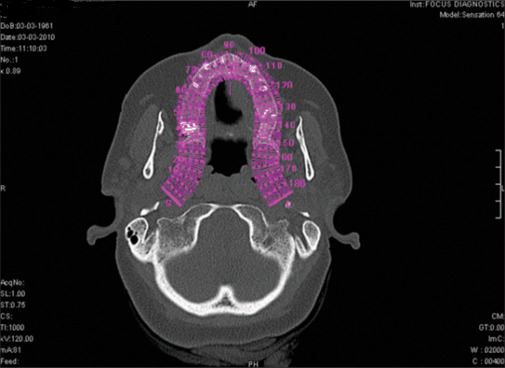
CBCT image 1: Axial view for potential implant site assessment
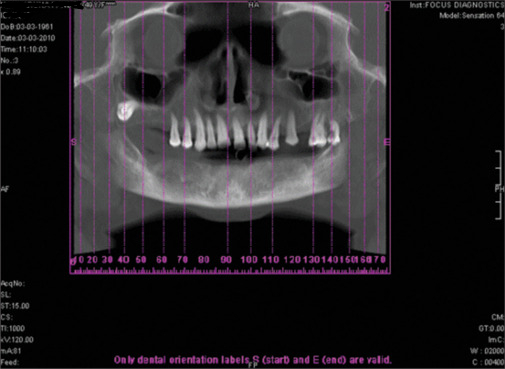
CBCT image 2: Panorama view
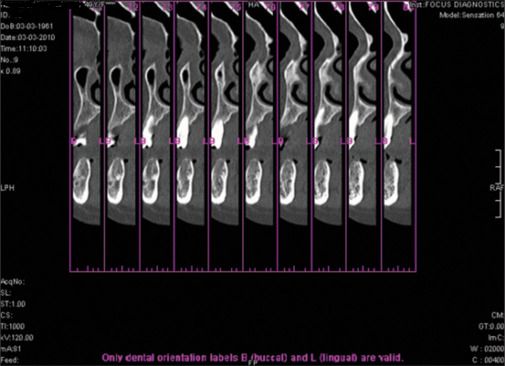
CS 3D imaging software used to assess the bone density (coronal section)
This case concluded:
CBCT is a useful tool to determine the bone density of the concerned areas before implant placement. The valuable information derived from the scan about the bone quality may help clinicians to avoid placement of implants into the very poorest qualities of bone, where failure is more likely. Bone density of interest areas obtained from CBCT scan can be used to make better treatment planning.
Our in vivo data, supported by the results of other studies, conclude that the preoperative CBCT assessment is a useful asset for predicting primary implant stability, which defines the success of dental implants. 6
References
-
Wada M, Tsuiki Y, Suganami T, Ikebe K, Sogo M, Okuno I, Maeda Y. The relationship between the bone characters obtained by CBCT and primary stability of the implants. Int J Implant Dent. 2015 Dec;1(1):3.
-
Pauwels R, Sessirisombat S, Panmekiate S. Mandibular Bone Structure Analysis Using Cone Beam Computed Tomography vs Primary Implant Stability: An Ex Vivo Study. Int J Oral Maxillofac Implants. 2017 Nov/Dec;32(6):1257-1265.
-
Mikic M, Vlahovic Z, Stevanović M, Arsic Z, Mladenovic R. The Importance of Correlation between CBCT Analysis of Bone Density and Primary Stability When Choosing the Design of Dental Implants-Ex Vivo Study. Tomography. 2022 May 11;8(3):1293-1306.
-
Feng L, Chen H, Chen Z, Chen Y, Gu X. Associations between cortical bone-to-implant contact and microstructure derived from CBCT and implant primary stability. Clin Oral Implants Res. 2023 Mar;34(3):243-253.
-
Shokri A, Armand N, Shahabi S, Torkzaban P, Tapak L, Poormoradi B. Evaluation of the Correlation Between the Structural Parameters of Trabecular Bone in CBCT and the Primary Stability of Dental Implants. Int J Oral Maxillofac Implants. 2024 Apr 24;39(2):271-277.
-
Khan TA, Syeda MS, Koppolu P, Afroz MM, Swapna LA. Bone mineral density as a criterion for primary implant stability: A retrospective CBCT analysis. Natl J Maxillofac Surg. 2025 Jan-Apr;16(1):126-133.
-
Badawy ST, Elmahdy AS, Badawi AT. The Prognostic Accuracy of Bone Density and Alveolar Ridge Width Estimated by CBCT in Predicting Primary Implant Stability: A Clinical Study. Int J Oral Maxillofac Implants. 2026 Aug 26;0(0):1-29.