This Week in Dental Implants we are highlighting a new randomized controlled trial that takes a closer look at a technique many clinicians have used for years: subperiosteal tunneling for horizontal ridge augmentation. The interesting part of the study for us wasn’t simply the tunneling vs flap results, but the comparison between tunneling with a membrane, and tunneling without a membrane.
What is the Tunnel Technique for Ridge Augmentation?
The basic concept behind tunneling is that a minimally‑invasive sub‑periosteal “tunnel” is created through a small (often U‑shaped) incision. The periosteum is preserved, a graft (autogenous bone, bovine xenograft, biphasic calcium phosphate, etc.) is placed inside the tunnel. Furthermore, some protocols recommend folding a collagen membrane or a custom‑made “sub‑periosteal bag” to contain the graft.
What are the potential benefits for the Tunnel Technique?
Traditional GBR techniques involve the elevation of a full‐thickness mucoperiosteal flap. The benefits of tunneling technique over the traditional flap include: 1
- Minimally invasive: Requires only small or sub‑periosteal incisions, preserving the periosteum and reducing tissue trauma and patient morbidity.
- Improved blood supply and wound healing: Preservation of the periosteum and an abundant blood supply promote favorable healing and lower the risk of flap dehiscence.
- Reduced complications: Soft‑tissue dehiscence, graft exposure, and infection are significantly lower than with crestal or conventional incision techniques.
- Reduced patient discomfort and postoperative pain: Fewer surgical fields and a short learning curve translate into less postoperative pain and faster recovery.
Can We Achieve Comparable Augmentation with the Tunnel Technique vs Traditional Flap?
Generally, all the historical studies we have found report favorable results with the Tunnel Technique, and the most recent study that is the subject of this post agreeing with these conclusions.
Specifically:
- Tunnel vs Open with titanium-reinforced PTFE membrane
A retrospective study compared horizontal ridge augmentation using a tunnel technique (using mineralized freeze-dried allograft and particulate bovine hydroxyapatite) with an open technique using a titanium-reinforced PTFE membrane. The tunnel approach had similar implant-readiness, but substantially fewer complications: 19% dehiscence vs. 52% with the PTFE technique, along with significantly fewer postoperative visits. The authors concluded:
For horizontal defects amenable to either technique, the findings of this study show the tunnel technique is a more cost-effective option with similar success to the open technique. 3
- Immediate or delayed implant surgery following tunneling technique.
This study included 25 patients and 39 implants. Patients received immediate or delayed implant surgery with bone graft (all different types) using U-shaped incision and tunneling technique. The authors concluded:
The bone graft material retained within a pouch formed using U-shaped incision and tunneling technique resulted with a few complications, and the prognosis of the implants placed above the alveolar bone was adequate. 4
- Lateral augmentation of a deficient alveolar ridge.
Ten lateral ridge augmentation were carried out using the sub-periosteal tunneling technique using a synthetic graft (biphasic calcium phosphate). The researchers found:
Within the limits of this pilot study, it can be concluded that sub-periosteal tunneling technique using in situ hardening biphasic calcium phosphate is a valuable option for lateral ridge augmentation to allow implant placement in deficient alveolar ridges. 5
- Finally, in the the latest study, Flap Versus Tunneling for Horizontal Ridge Augmentation:
Study design: Randomized controlled clinical trial
Patients: 45 initially; 43 included in the final analysis
Follow-up: 6 months
Graft: Freeze-dried bone allograft (FDBA) + injectable PRF (i-PRF)
The patients were randomized into three groups:
- Conventional flap + collagen membrane (CF)
- Tunneling + collagen membrane ™
- Tunneling without membrane (TnM)
The investigators evaluated ridge width using CBCT and also performed histomorphometric analysis at implant placement.
The researchers concluded:
All treatment modalities resulted in increased ridge width after 6 months, with the most substantial gains at 4 mm and 6 mm levels. The TM group exhibited the smallest increase at 2 mm, and the CF group showed comparatively lower gains at 4 mm and 6 mm levels than the tunneling approaches. Nevertheless, intergroup differences at all measured levels did not reach statistical significance…These findings suggest that tunneling, whether performed with or without a membrane, can achieve ridge width gain comparable to techniques employing space‐maintaining approaches. 6
In should further be pointed out that in the recent study, No wound dehiscence occurred in either tunneling group, while three patients in the conventional flap group experienced minor wound dehiscence.
Is a Membrane Required in the the Tunneling Procedure to Ensure Ideal Regeneration?
We think the question of the membrane is probably the most interesting question with regards to the tunneling technique. Interestingly, few of the previous studies mentioned above used a membrane. However, none of these studies did a direct comparison between tunneling with a membrane and without a membrane. In Flap Versus Tunneling for Horizontal Ridge Augmentation, the researchers did in fact compare both techniques. They found that:
The tunneling without membrane (TnM) group demonstrated greater ridge width gains at the 4 and 6 mm levels compared with other treatment groups. 6
This suggests to them that:
Given the technical challenges of membrane placement in tunneling procedures due to limited access, both current and prior evidence indicate that membrane use may not provide substantial clinical advantages in this context. 6
But, we do not think these results can be generalized to all cases, because, there are some interesting biological reasons why the researchers got this result. Specifically, the authors used FDBA combined with i-PRF. The fibrin component can help bind particulate graft material together and may improve graft handling and stability. Meanwhile, the tunnel itself preserves the periosteal/soft-tissue envelope over the graft.
So instead of thinking about the membrane as the only mechanism responsible for maintaining the regenerative environment, we think the basic idea to think about is : stable graft + preserved periosteum + soft-tissue containment + biologically active fibrin matrix as potentially providing enough stability for selected defects.
So we certainly think that this study provides further support that in some instances, particularly when you have a stable graft and soft-tissue containment a membrane may not be required.
 The Key Takeaway for Tunneling
Tunneling may or may not give you more bone than a traditional flap, but it may give you comparable bone to traditional GBR with less surgical exposure or other risks . Furthermore, in selected horizontal ridge defects, a well-executed tunneling approach, where the graft is properly contained, for example as sticky bone (iPRF), then it is possible that adding a membrane may not always be necessary when FDBA.
For specific defects, you can also consider DALI Flex Graft Cortical Sheet, which has been used successfully without a membrane.
Tunneling Technique Case Photos
Flap Versus Tunneling for Horizontal Ridge Augmentation Photos
Image Sources:
Heidaryzadeh M, Mohammadi M, Lashkarizadeh N, Khandani MK. Flap Versus Tunneling for Horizontal Ridge Augmentation With FDBA and i-PRF: A Randomized Controlled Clinical Trial. 6
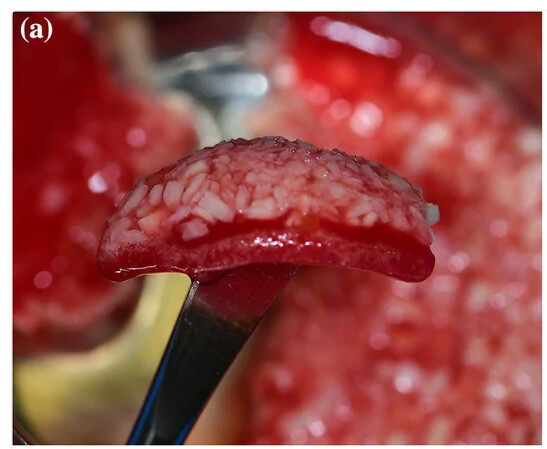
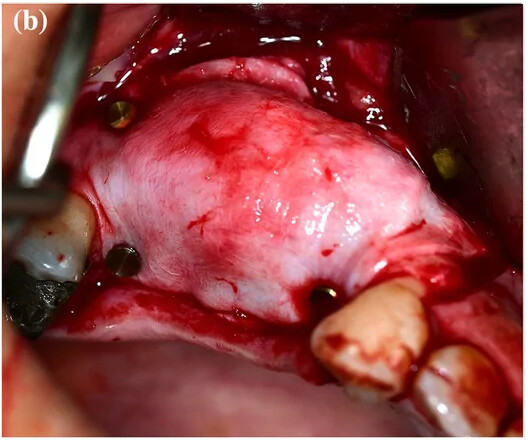
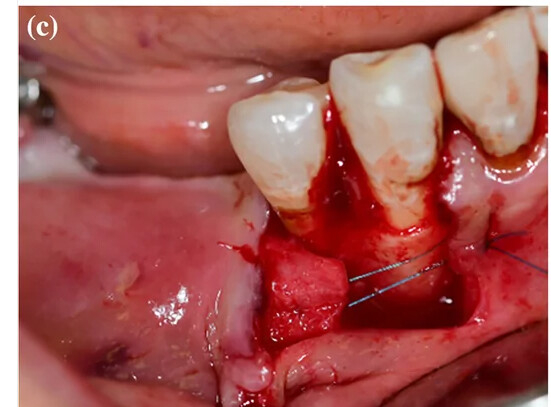
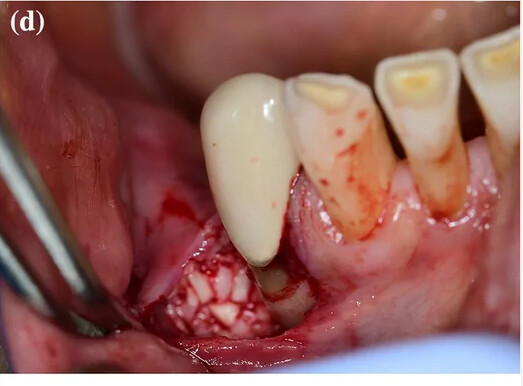
Clinical steps of horizontal ridge augmentation. (a) Placement of FDBA combined with i‐PRF, (b) conventional flap closure, (c) tunneling technique with membrane placement, and (d) tunneling technique without membrane application.
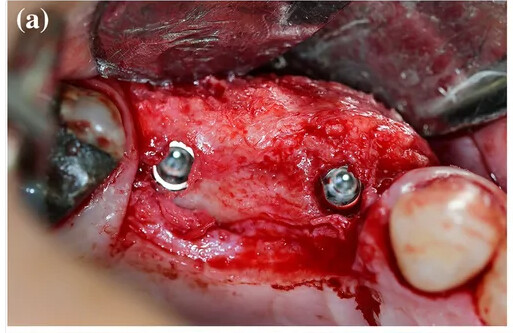
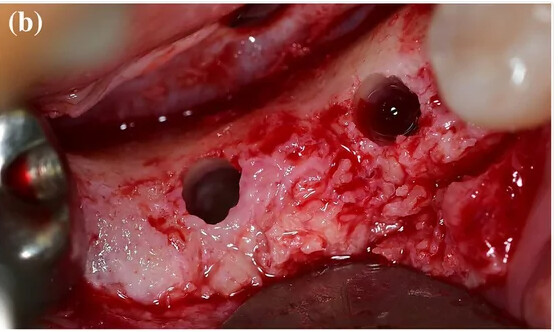
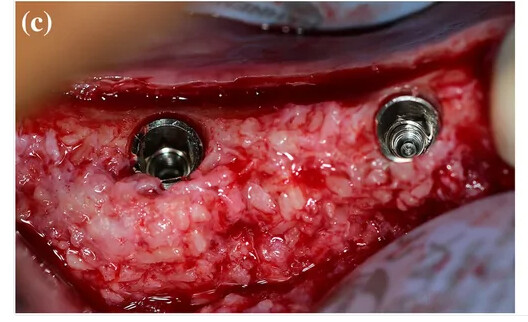
Clinical views of the augmented ridge at the time of implant placement in the (a) conventional flap, (b) tunneling technique with membrane, and (c) tunneling technique without membrane groups.
Photos Minimal invasive horizontal ridge augmentation using subperiosteal tunneling technique
Image Sources:
Kim HS, Kim YK, Yun PY. [Minimal invasive horizontal ridge augmentation using subperiosteal tunneling technique. 4
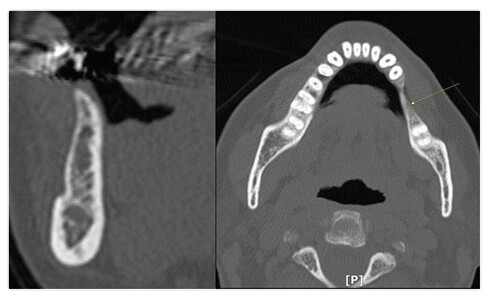
CBCT, preoperative view. The alveolar bone of #35, 36 (tooth loss state) was deficient severely. It needed bone graft to increase the width of alveolar bone where implant could be placed
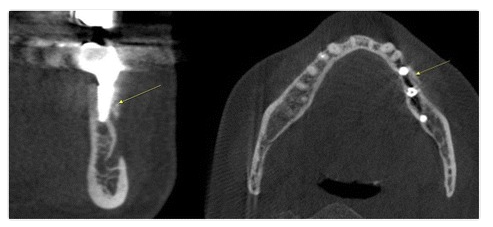
CBCT, 2 years after the restoration. The alveolar bone where bone graft using the tunneling technique is marked by a yellow arrow
Case Photos for Lateral alveolar ridge augmentation procedure using subperiosteal tunneling technique
Source of Images:
Kakar A, Kakar K, Sripathi Rao BH, Lindner A, Nagursky H, Jain G, Patney A. [Lateral alveolar ridge augmentation procedure using subperiosteal tunneling technique: a pilot study.] 5
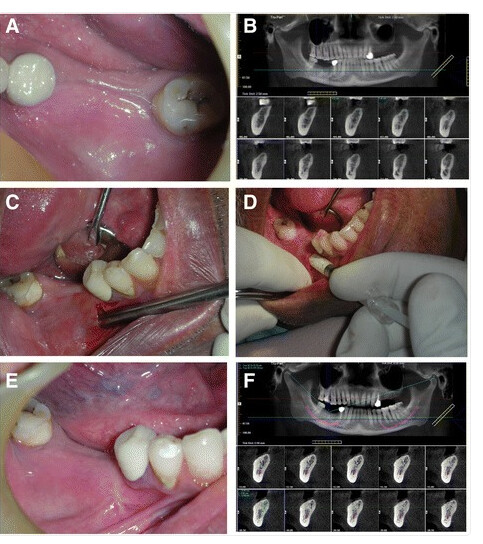
a Clinical situation with missing mandibular molars. b Preoperative CBCT showing deficient alveolar ridge width. c 5-mm vertical incision made for tunnel preparation and periosteal dissection for the tunnel. d Easy-graft CRYSTAL being injected into the prepared tunnel. e Postoperative healing. Notice the minimal area of scarring at the vertical incision site. f Postoperative CBCT showing increased ridge width and graft consolidation
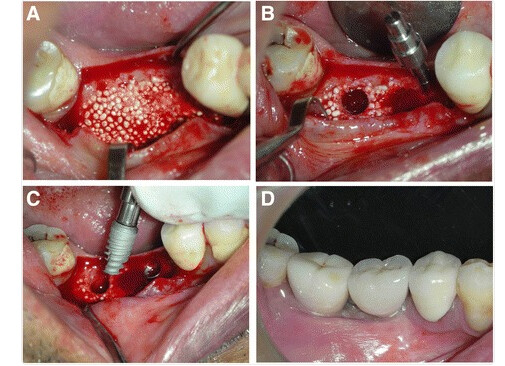
a Mucoperiosteal flap reflection post healing and graft consolidation showing the graft well integrated into the native bone and an increased width of the alveolar ridge. b Two core biopsy samples harvested from the augmented area. Anterior implant preparation was done. c Implant insertion into the site. Note that a wide-diameter implant was placed into the second molar area. d Two individual implant crowns were placed as the final prosthesis
Resources
- Karmon B, Tavelli L, Rasperini G. Tunnel Technique with a Subperiosteal Bag for Horizontal Ridge Augmentation. Int J Periodontics Restorative Dent. 2020 Mar/Apr;40(2):223-230.
- Mazzocco C, Buda S, De Paoli S. The tunnel technique: a different approach to block grafting procedures. Int J Periodontics Restorative Dent. 2008 Feb;28(1):45-53.
- Deeb GR, Wilson GH, Carrico CK, Zafar U, Laskin DM, Deeb JG. Is the Tunnel Technique More Effective Than Open Augmentation With a Titanium-Reinforced Polytetrafluoroethylene Membrane for Horizontal Ridge Augmentation? J Oral Maxillofac Surg. 2016 Sep;74(9):1752-6.
- Kim HS, Kim YK, Yun PY. Minimal invasive horizontal ridge augmentation using subperiosteal tunneling technique. Maxillofac Plast Reconstr Surg. 2016 Nov 5;38(1):41.
- Kakar A, Kakar K, Sripathi Rao BH, Lindner A, Nagursky H, Jain G, Patney A. Lateral alveolar ridge augmentation procedure using subperiosteal tunneling technique: a pilot study. Maxillofac Plast Reconstr Surg. 2018 Feb 25;40(1):3.
- Heidaryzadeh M, Mohammadi M, Lashkarizadeh N, Khandani MK. Flap Versus Tunneling for Horizontal Ridge Augmentation With FDBA and i-PRF: A Randomized Controlled Clinical Trial. Clin Implant Dent Relat Res. 2026 Oct;28(5):e70179.