This Week in Dental Implants we wanted to cover demineralized dentin matrix (DDM) given two new recent studies that were recently published on DDM, related to its efficacy in alveolar ridge preservation and sinus crestal elevation. Both studies yielded positive results, as we summarize below. But, first a basic overview of demineralized dentin matrix (DDM) .
What is Demineralized dentin matrix (DDM)?
Demineralized dentin matrix (DDM) is a biologically‑derived scaffold obtained by removing the mineral phase of dentin while preserving most of its organic components (mainly type I collagen and non‑collagenous proteins).
How is Demineralized dentin matrix (DDM) produced?
- Dentin is treated with demineralizing agents such as ethylene‑diamine‑tetraacetic acid, 0.6 N HCl, or 2 % nitric acid.
- These protocols eliminate the bulk of hydroxyapatite, leaving a porous collagen‑rich matrix that still contains numerous growth factors.
- The material can be sterilized, preserved, and processed into various forms (particles, powders, blocks, slices, sheets, hydrogel, paste, or barrier membranes) and sizes (micrometres to millimetres).
Processes and steps used to prepare demineralized dentin matrix (DDM) for clinical applications starting with the different sources used for tissue harvesting.
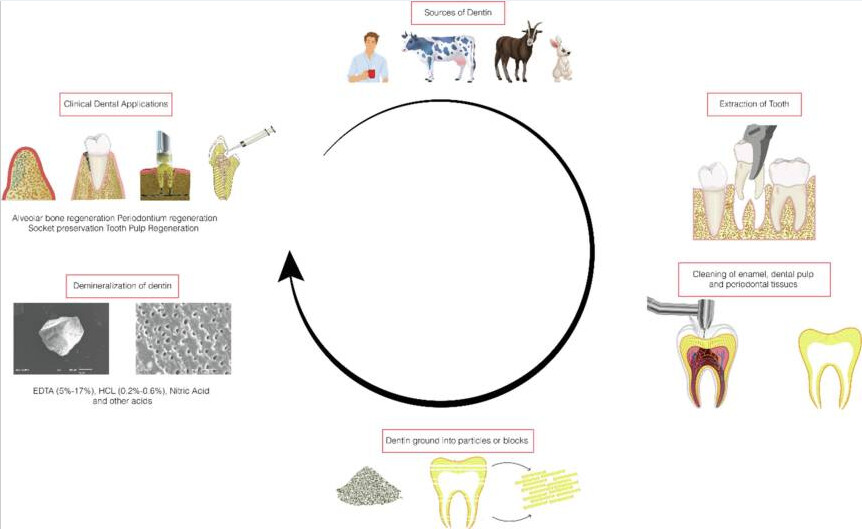
(Image courtesy of: Khurshid Z, Adanir N, Ratnayake J, Dias G, Cooper PR. Demineralized dentin matrix for bone regeneration in dentistry: A critical update.)
Recent Studies on Demineralized dentin matrix (DDM)
Alveolar ridge preservation (ARP): Autogenous demineralized dentin matrix (DDM) vs deproteinized bovine bone mineral (DBBM)?
Fifty patients were randomly assigned to either the DDM or DBBM group. By 6 months, no significant differences were found between groups in horizontal or vertical bone loss.
The study concluded that:
Although autogenous DDM exhibited a faster remodeling rate and dimensional contraction in the early healing phase (3 months), it achieved long-term (6-month) dimensional stability comparable with that of the gold-standard xenograft. Furthermore, histological evidence of superior tissue integration suggests that DDM is a biologically viable and cost-effective alternative for alveolar ridge preservation. 1
Is demineralized dentin matrix (DDM) effective as a graft material in Sinus Elevation?
55 implants placed with transcrestal sinus floor elevation and DDM grafting in the posterior maxilla. After an average follow-up of 48 months, all implants remained functional, resulting in a 100% survival rate. Greater bone gain was observed in implants protruding ≥4 mm and in narrower sinuses. No significant sinus complications or graft failures were reported.
The study concluded that:
This study evaluated the clinical and radiographic outcomes of using demineralized dentin matrix (DDM) as a graft material at the implant apex during crestal sinus floor elevation. We hypothesized that DDM would promote predictable bone regeneration at the sinus floor and facilitate implant stability with minimal surgical morbidity. 2
Case Photos for Demineralized dentin matrix (DDM)
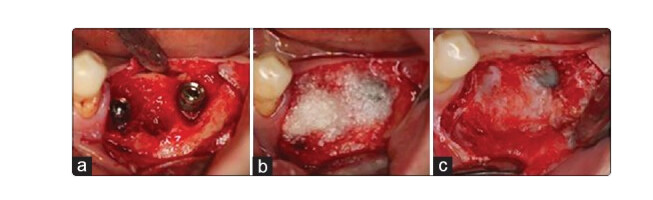
(Case photo from: Um IW, Kim YK, Mitsugi M. Demineralized dentin matrix scaffolds for alveolar bone engineering.
(a) The defect around the implant, (b) defects are covered by the demineralized dentin matrix particles, (c) texture of newly formed bone after 3 months. Most of the demineralized dentin matrix powder underwent resorption and bone remodeling
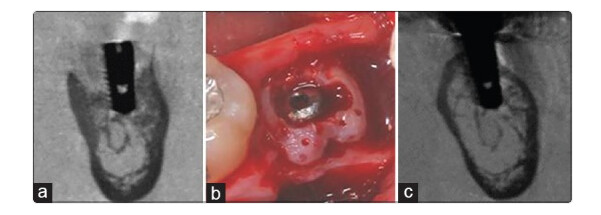
(Case photo from: Um IW, Kim YK, Mitsugi M. Demineralized dentin matrix scaffolds for alveolar bone engineering.
(a) The vertical and horizontal alveolar defect around the implant, (b) the defect repaired by the demineralized dentin matrix block and blood clot aggregation, (c) complete formation of corticocancellous bone. Over time, the demineralized dentin matrix block underwent gradual resorption and became less visible
References
- Xu Y, Zhang H. Clinical, radiographic, and histological evaluation of autogenous demineralized dentin matrix versus xenograft in alveolar ridge preservation: a randomized controlled trial. Int J Implant Dent. 2026 May 22.
- Kwon JH, Kim Y, Um IW, Yun PY, Ku JK. Efficacy of sinus crestal elevation with demineralized dentin matrix at the apex of the implants. Int J Implant Dent. 2026 Apr 21. doi: 10.1186/s40729-026-00681-7.
- Um IW, Kim YK, Mitsugi M. Demineralized dentin matrix scaffolds for alveolar bone engineering. J Indian Prosthodont Soc. 2017 Apr-Jun;17(2):120-127.
- Khurshid Z, Adanir N, Ratnayake J, Dias G, Cooper PR. Demineralized dentin matrix for bone regeneration in dentistry: A critical update. Saudi Dent J. 2024 Mar;36(3):443-450. doi: 10.1016/j.sdentj.2023.11.028. Epub 2023 Nov 28.