This Week in Dental Implants we are reviewing two Alternatives to Conventional Osteotomy for implant placement.
Conventional Osteotomy for Implant Placement
A conventional osteotomy is the traditional surgical method used to prepare the bone site for a dental implant. It involves the sequential use of the manufacturer‑provided drills (usually in a clockwise rotation) to remove bone tissue and create a socket of the required diameter and depth. In contrast to newer approaches (e.g., osseodensification) that compact and autograft bone while expanding the osteotomy, the conventional method simply excavates bone to make space for the implant.
Key characteristics:
| Feature | Description |
|---|---|
| Technique | Drilling removes (excavates) bone rather than compacting it. |
| Sequence | A series of progressively larger drills is followed according to the implant system’s protocol; the final drill usually matches the planned implant diameter. |
| Goal | Produce an osteotomy that fits the implant while achieving primary stability. In low‑density bone, clinicians may deliberately under‑prepare (skip the last drill) to obtain a smaller osteotomy and increase insertion torque. |
| Biomechanical effect | Bone removal may result in lower bone density around the implant compared with densification techniques, and excessive compression can risk microcracks or ischemia. |
| Typical outcomes | Adequate primary stability when the protocol is followed, but bone density around the implant is generally lower than that obtained with newer methods such as osseodensification. |
Alternative Approach: Osseodensification
Osseodensification is a modern, non‑subtractive bone‑instrumentation technique used for preparing dental‑implant sites.
- It employs specially designed burs (e.g., Densah® or Versah OD burs) that have a large negative rake angle.
- When the burs rotate counter‑clockwise at 800–1,500 rpm, they compact and autograft the surrounding trabecular bone rather than cutting it away.
- This process preserves collagen, enhances bone plasticity, and creates a densified osteotomy wall that provides a “spring‑back” effect, improving primary implant stability and bone‑to‑implant contact.
- The technique can be applied in various clinical situations, such as low‑density posterior maxilla, ridge expansion, sinus floor elevation, and immediate implant placement.
Benefits of Osseodensification (OD)
- Higher primary stability – Counter‑clockwise drilling compacts autogenous bone, giving markedly higher insertion torque and ISQ values (average 73 kHz vs ≈ 58 kHz with conventional drilling).
- Increased bone density and bone‑to‑implant contact – Studies show significantly greater bone density around implants (median 1,020 HU vs 732 HU) and comparable or improved bone‑implant contact after healing.
- Preservation and densification of bulk bone – The non‑subtractive technique expands the osteotomy while retaining and compacting native bone, creating autograft “healing chambers” without loss of volume.
- Improved secondary stability and reduced crestal bone loss – Compacted bone acts as an autograft, supporting osseointegration and yielding lower crestal bone loss (≈ 0.58 mm vs 0.64 mm with conventional drills).
- Higher implant survival rates – Retrospective analyses of 211 implants report a 98.1 % overall survival (99.2 % for immediate loading) and comparable or better outcomes than conventional instrumentation.
- Enhanced outcomes in low‑density and challenging sites – OD delivers better stability in posterior maxilla, narrow alveolar ridges, and areas with poor bone quality, facilitating immediate placement and loading.
- Greater bone gain in sinus augmentation – When used for transcrestal sinus lifts, OD achieves more vertical bone gain (10–13.6 mm), higher bone density, and shorter surgical time compared with piezoelectric techniques.
- Faster healing and higher patient/clinician satisfaction – Clinical trials note rapid postoperative healing, fewer complications, and superior patient‑reported outcomes.
- Versatility – Applicable for sub‑antral grafts, narrow crests, immediate implant placement in extraction sockets, and delayed implant placement after sinus elevation.
Case: A comparative study on bone density before and after implant placement using osseodensification technique
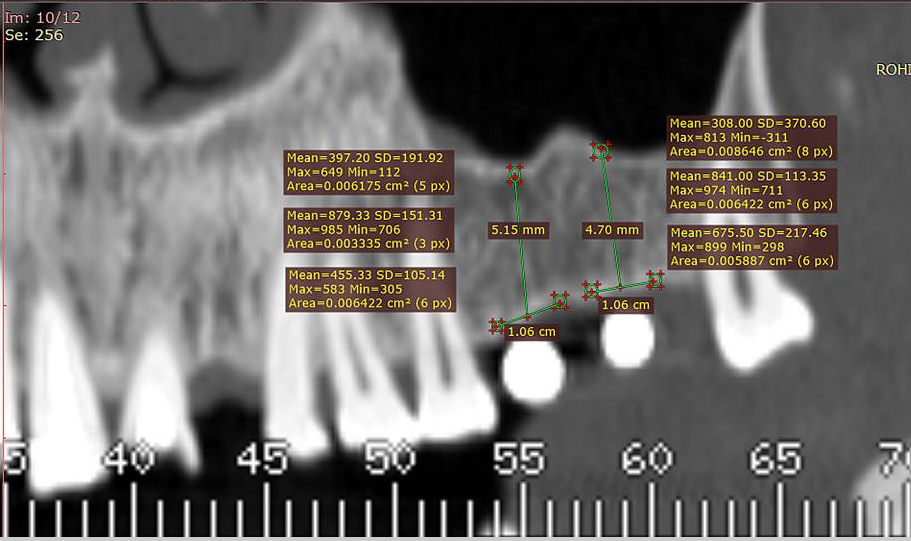
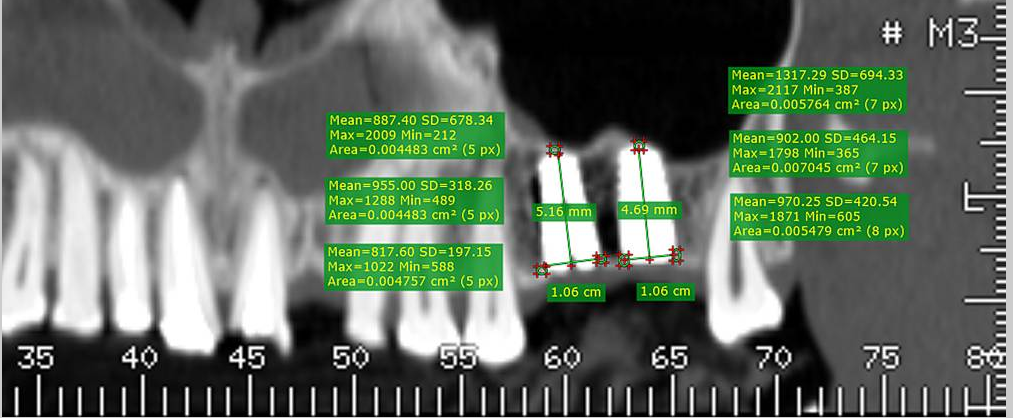
Case by: Vaddamanu SK, Saini RS, Vyas R, Kanji MA, Alshadidi AAF, Hafedh S, Cicciù M, Minervini G. A comparative study on bone density before and after implant placement using osseodensification technique: a clinical evaluation.
The findings from this study demonstrate that osseodensification, through the use of specialized drills in a counter-clockwise direction, significantly enhances bone density at the osteotomy site, particularly in the distal direction where the greatest bone density is observed, followed by the mesial and then the apical areas. This densification process not only preserves but also augments bone volume and quality by compacting autografted bone laterally and apically, thereby improving primary stability and facilitating bone healing around the implant. The osseodensification technique emerges as a groundbreaking, bone-preserving method for osteotomy preparation, offering additional benefits such as potential indirect sinus lifting and alveolar ridge expansion. This technique represents a significant advancement in implant dentistry, promoting better outcomes for implant stability and longevity.
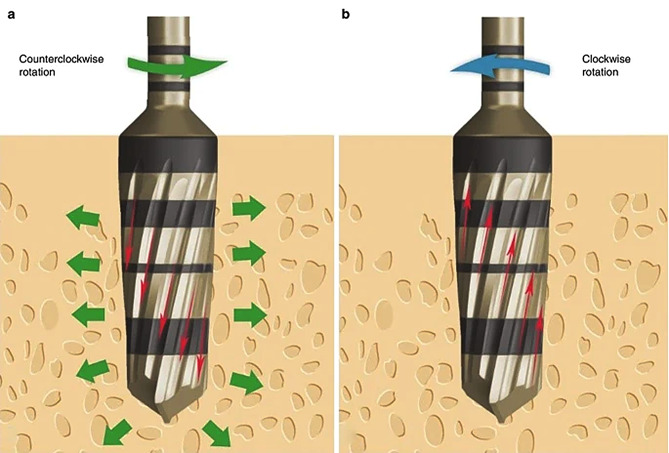
a ) graphical representation of osseodenstification technique b ) graphical representation of implant site preparation
Newer Approaches: Is the Osteotomy Needed in Immediate Implant Placement?
This case series evaluates the feasibility of placing implants without osteotomy in fresh extraction sockets using a novel implant design. …The findings suggest that immediate dental implants placed without osteotomies in select anatomical conditions can achieve successful osseointegration and functional stability. 4
Case: Placement of Immediate Implant (Megagen Anyridge) without Osteotomy
Case by: Thanos Dounis,Valeria Jimenez Ortiz et al., Clinical and experimental dental research. Volume: 11, Issue: 3, 202, Dental Implants Placed in Fresh Human Extraction Sockets Without Osteotomy: A Case Series.
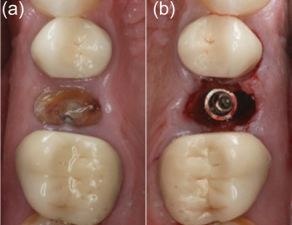
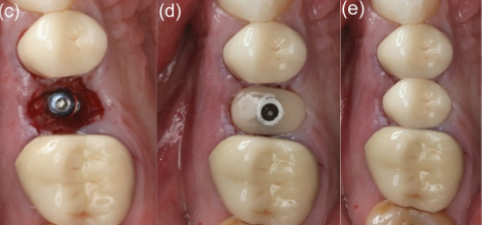
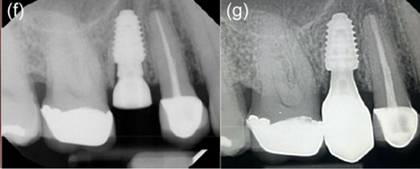
Minimally invasive removal of fractured premolar and placement of immediate implant (Megagen Anyridge) without osteotomy on Patient 3: (a) Fractured non‐restorable premolar. (b) Prepless immediate implant. (c) Cover screw placed to accommodate grafting with cortical cancellous allograft. (d) Anatomical healing abutment placed on the day of surgery. (e) Final monolithic Zr restoration. (f) Peri‐apical radiograph of day of surgery with anatomical healing abutment. (g) Peri‐apical radiograph with definitive restoration at 12 months.
Case: Minimally invasive removal of fractured central incisor and placement of immediate implant (Megagen Anyridge) without osteotomy
Case by: Thanos Dounis,Valeria Jimenez Ortiz et al., Clinical and experimental dental research. Volume: 11, Issue: 3, 202, Dental Implants Placed in Fresh Human Extraction Sockets Without Osteotomy: A Case Series.
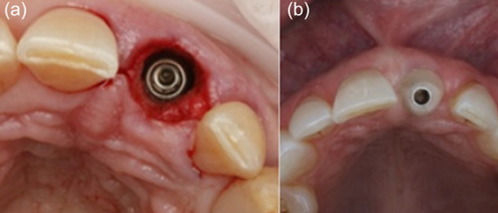
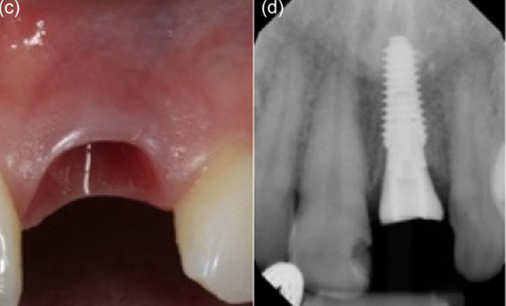
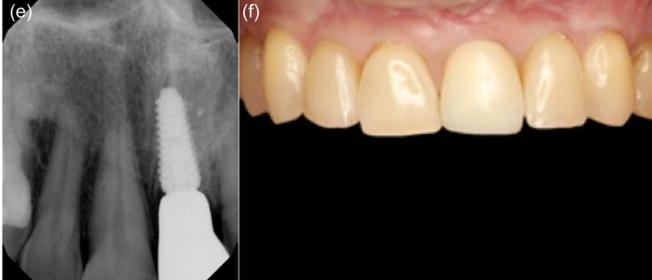
Minimally invasive removal of fractured central incisor and placement of immediate implant (Megagen Anyridge) without osteotomy on Patient 1: (a) Immediate prepless immediate implant on central incisor. (b) Anatomical healing abutment placed. (c) Transmucosal tunnel and emergence profile development by anatomical healing abutment. (d) Peri‐apical radiograph on the day of implant placement with anatomic healing abutment. (e) Peri‐apical radiograph with final restoration at 12 months. (f) Definitive monolithic Zr restoration.
References
-
Osteotomy preparation: Traditional implant placement vs immediate placement
Traditional implant placement requires osteotomy preparation through a series of progressively increasing diameters of drills. The rationale for th…
Thanos Dounis,Valeria Jimenez Ortiz et al., Clinical and experimental dental research. Volume: 11, Issue: 3, 2025 -
Osseodensification vs. Conventional Osteotomy: A Case Series with Cone Beam Computed Tomography.
Osseodensification is a non-extraction technique using specially designed drills to increase bone density while extending an osteotomy, allowing …
José Adriano Costa,José Manuel Mendes,Filomena Salazar,José Júlio Pacheco,Paulo Rompante,Joaquim Ferreira Moreira,José Diogo Mesquita,Nuno Adubeiro,Marco Infante da Câmara et al., Journal of clinical medicine. Volume: 13, Issue: 6, 2024 -
Osseodensification technique in crestal maxillary sinus elevation—A narrative review
A commonly used surgical approach to reach higher primary implant stability, mainly in low‐density bone, comprises the implant placement in a subst…
João Gaspar,Ziv Mazor,Estevam A Bonfante et al., Clinical implant dentistry and related research. Volume: , Issue: , 2024 -
Dental Implants Placed in Fresh Human Extraction Sockets Without Osteotomy: A Case Series.
This case series evaluates healing parameters of immediately placed implants in fresh extraction sockets without osteotomie…
Thanos Dounis,Valeria Jimenez Ortiz et al., Clinical and experimental dental research. Volume: 11, Issue: 3, 202 -
A comparative study on bone density before and after implant placement using osseodensification technique: a clinical evaluation. Int J Implant Dent. 2024 Nov 19;10(1):56. Vaddamanu SK, Saini RS, Vyas R, Kanji MA, Alshadidi AAF, Hafedh S, Cicciù M, Minervini G.
-
Conventional Versus Osseodensification Drilling in the Narrow Alveolar Ridge: A Prospective Randomized Controlled Trial.
Conventionally, undersized osteotomies were used to increase initial bone-to-implant contact to achieve primary stability in implantolog…
Mohanasatheesh Shanmugam,Mohan Valiathan,Anitha Balaji,Angelin Fiona Jeyaraj Samuel,Rudra Kannan,Vishnu Varthan et al., Cureus. Volume: 16, Issue: 3, 2024 -
Overview of the osseodensification technique
In contrast to traditional drilling techniques, which remove bone to create osteotomies, the advent of osseodensification, a technique developed by…
Sunil Kumar Vaddamanu,Ravinder S Saini,Rajesh Vyas et al., International journal of implant dentistry. Volume: 10, Issue: 1, 2024 -
Osseodensification: An Alternative to Conventional Osteotomy in Implant Site Preparation: A Systematic Review
Osseodensification is an innovative method of preparing the implant osteotomy using drills that promote bone self-compaction. The main objective of…
Fontes Pereira J, Costa R, Nunes Vasques M,Salazar F et al., J Clin Med. 2023 Nov 11;12(22):7046. -
The Effects of Clockwise and Counterclockwise Conventional and Osseodensification Drilling on the Dimensions, Density, and Biomechanical Properties of Bone.
To compare the effects of regular implant drills to osseodensifying drills used in clockwise and counterclockwise motions on bone dimension change …
Niloufar Daneshparvar,Tien-Min Chu,Steven Blanchard,Yusuke Hamada et al., The International journal of oral & maxillofacial implants. Volume: 38, Issue: 1, 2023 Jan-Feb