This Week in Dental Implants we are highlighting four studies with meaningful implications for everyday implant and periodontal practice. First, a quasi-randomized clinical trial takes a closer look at implantoplasty extent in peri-implantitis surgery, finding that extending the procedure into the intrabony compartment may offer added clinical and radiographic gains. On the technology front, a timely study benchmarks ChatGPT-5, Gemini 2.5 Pro, and Claude Sonnet 4 against prosthodontic residents on national board examinations, with LLMs outperforming residents in most domains! Shifting to periodontal adjuncts, a double-blind RCT finds that probiotic lozenges containing Lacticaseibacillus rhamnosus and Latilactobacillus curvatus provided short-term microbiological and clinical improvements when added to non-surgical periodontal therapy. Finally, a 10-year multicenter RCT offers long-awaited longitudinal data on subcrestal implant placement depth, concluding that 0.5 mm versus 1.5 mm submersion makes little difference in outcomes when adequate surrounding bone is present. Read on for the full summaries.
Case: Extent of Implantoplasty in the Combined Surgical Therapy of Peri‐Implantitis: A Quasi‐Randomized Clinical Trial
This study compared the clinical and radiographic performance of full‑length implantoplasty (FLIP) versus partial‑length implantoplasty (PLIP) limited to the supracrestal component, when both are combined with regenerative therapy for peri‑implantitis lesions that have a ≥ 3 mm intrabony component. It concluded:
Combined surgical therapy for peri‐implantitis, including implantoplasty and regeneration of the intrabony component, is effective in arresting disease progression and restoring peri‐implant health. Extending implantoplasty to the contained intrabony compartment appears to provide additional clinical and radiographic benefits. However, this advantage comes at the expense of increased mucosal recession, highlighting the need for careful case selection and patient counseling. 1
Case Photos
(Case Photos from: Monje A, Pons R, Aparicio C, Tarnow D, Rosen PS, Nart J. Extent of Implantoplasty in the Combined Surgical Therapy of Peri-Implantitis: A Quasi-Randomized Clinical Trial.
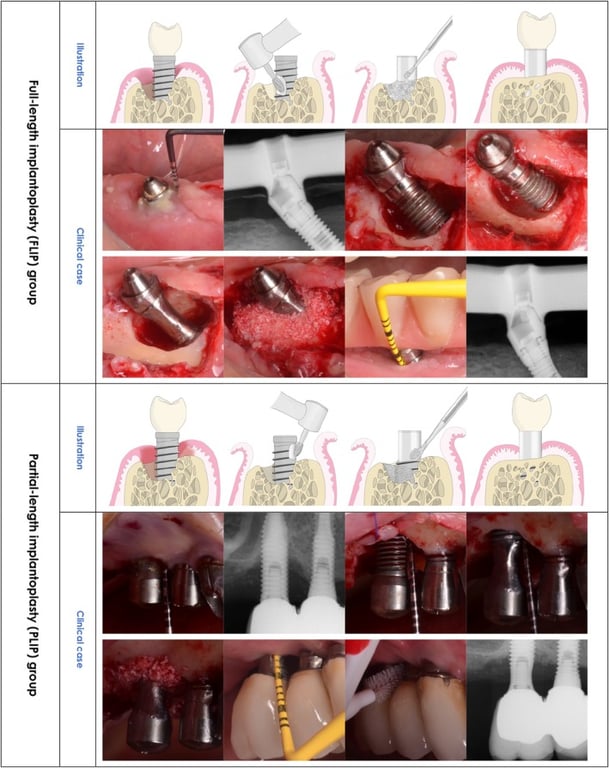
Clinical presentation and outcome for FLIP and PLIP.
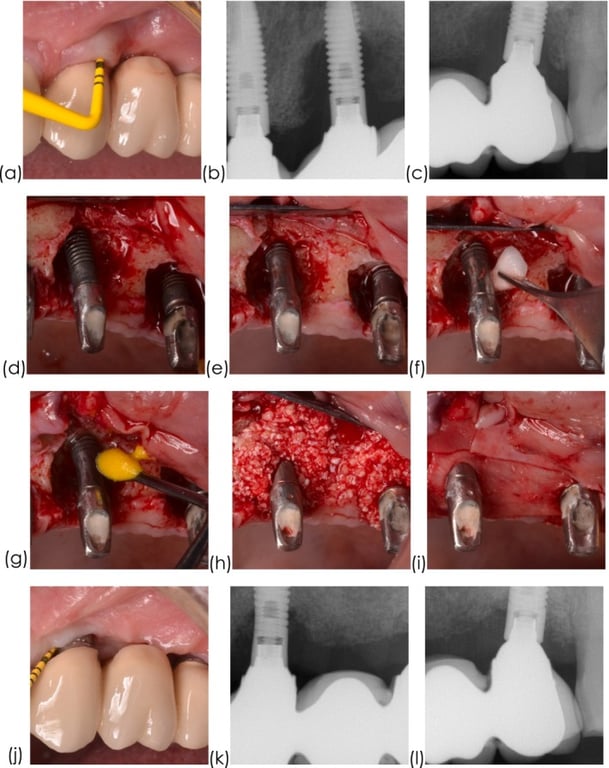
Representative case of FLIP. (a) clinical presentation following non‐surgical therapy, (b–c) periapical radiographic displaying advanced bone loss, (d) intra‐operative presentation showing combined defects, (e) implantoplasty along the supracrestal and intrabony components, (f) chemical decontamination applying hydrogen peroxide, (g) pharmacological decontamination using tetracycline chlorhydrate, (h) mixture of autogenous bone with xenograft, (i) collagen membrane is used to enhance graft stability, (j) clinical outcome showing disease resolution, (k–l) radiographic marginal bone level gain.
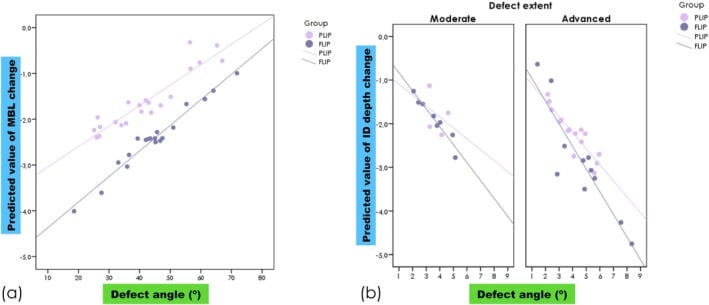
Plots showing the predicted value of marginal bone level change (a) and intrabony defect depth change (b) according to defect angle at baseline examination
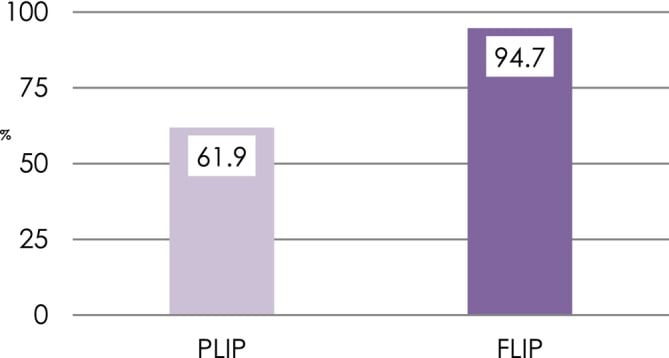
Disease resolution for PLIP and FLIP.
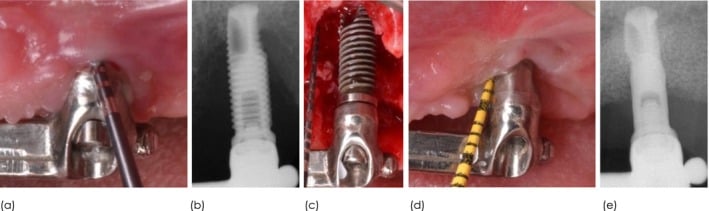
Representative case of FLIP. (a) clinical presentation following non‐surgical therapy, (b) advanced radiographic bone loss, (c) intraoperative image of the combined defect, (d) clinical disease resolution, (e) radiographic marginal bone level gain.
Evaluating the performance of large language models versus prosthodontic residents on the 2024 and 2025 National Prosthodontic Resident Examination
This study the performance of three advanced LLMs—ChatGPT‑5, Gemini 2.5 Pro, and Claude Sonnet 4—with prosthodontic residents on the 2024 and 2025 National Prosthodontic Resident Examinations (NPREs). It concluded:
LLMs demonstrated high accuracy on consecutive national prosthodontic examinations and surpassed residents in most domains. Resident advantages in a few areas requiring contextual interpretation indicate domains in which resident accuracy exceeded model accuracy. LLMs show promise as supplemental educational tools, but responsible use requires AI literacy, verification skills, and assessment strategies that emphasize higher-order reasoning. 2
Probiotics Augment the Effect of Non-Surgical Periodontal Treatment-A Randomised, Double-Blinded, Placebo-Controlled Trial
The aim of this study was to determine the effect of probiotic lozenges containing Lacticaseibacillus rhamnosus PB01, Latilactobacillus curvatus EB10 and xylitol after non-surgical periodontal treatment (NSPT). It concluded:
The tested probiotic supplement resulted in an additional short-term decrease in periodontitis-associated species along with greater improvements in BoP% and PPD ≥ 5 mm 12 weeks post-NSPT, compared to the placebo group. 3
Ten-Year Post-Loading Outcomes of Subcrestally Placed Implants With Internal Conical Connections at 0.5 mm Versus 1.5 mm Depth: A Multicentre Within-Person Randomised Controlled Trial
This study evaluated whether placing single dental implants either 0.5 or 1.5 mm subcrestally in healed bone crests confers any clinical benefits. It concluded:
Subcrestal implant placement at either 0.5 or 1.5 mm, when at least 1 mm of surrounding bone is present, seems not to affect the long-term outcomes. 4
References
-
Monje A, Pons R, Aparicio C, Tarnow D, Rosen PS, Nart J. Extent of Implantoplasty in the Combined Surgical Therapy of Peri-Implantitis: A Quasi-Randomized Clinical Trial. Clin Implant Dent Relat Res. 2026 Apr;28(2):e70144.
-
Prasad S, Fang Q, Koseoglu M, Shembesh M, Gheisarifar M, Sukotjo C. Evaluating the performance of large language models versus prosthodontic residents on the 2024 and 2025 National Prosthodontic Resident Examination. J Prosthet Dent. 2026 Apr 15:S0022-3913(26)00234-9.
-
Lundtorp-Olsen CM, Andersen SVR, Massarenti L, Gürsoy M, Splunter AV, Bikker FJ, Gursoy UK, Markvart M, Damgaard C, Belstrøm D. Probiotics Augment the Effect of Non-Surgical Periodontal Treatment-A Randomised, Double-Blinded, Placebo-Controlled Trial. J Clin Periodontol. 2026 May 4.
-
Esposito M, Visconti RF, Gualini F, Rigotti F, Mazzarini C, Longhin D, Grigoletto M, Giudice A, Greco K, Salina S. Ten-Year Post-Loading Outcomes of Subcrestally Placed Implants With Internal Conical Connections at 0.5 mm Versus 1.5 mm Depth: A Multicentre Within-Person Randomised Controlled Trial. Clin Oral Implants Res. 2026 Apr 28.