If you’ve done full-arch implant treatment, you’ve certainly considered the All-on-4 protocol. But what about its close relative, All-on-6, which uses two additional implants? A new long-term study on the maxillary provides a good reason for us to take a closer look. This Week in Dental Implants, we review where All-on-4 came from, what the research says about it, why some clinicians prefer six, where All-on-6 has limits, and what the newest study adds.
Background: What Is All-on-4?
All-on-4 was described by Maló and colleagues in 2003 as a simple, safe surgical and prosthetic protocol in which a fixed prosthesis is attached to the implants within about two hours of surgery [1]. Generally, two implants are placed upright at the front of the jaw and two are tilted toward the back [2].
The idea behind tilting the back implants is that angling them allows the use of longer implants, stays clear of vital structures such as the nerve in the mandibular, and spreads the implants farther apart, which reduces the length of the prosthesis that extends beyond the last implant (the cantilever) [4]. Four to six implants for a full arch was already the foundation laid by Brånemark, so All-on-4 is best understood as a streamlined, immediate-function version of that approach [3, 4].
Previous Research on All-on-4
The original study (2003). Maló et al. followed 44 patients with 176 immediately loaded implants in the lower jaw. Five implants were lost in five patients before the 6-month check, giving cumulative implant survival of 96.7% and 98.2% in the two study groups. Every prosthesis survived, and bone loss was low [1].
Twenty-plus years later (2026). De Araújo Nobre and colleagues followed 181 patients with 724 implants for an average of 22 years. Cumulative survival was 90% for implants and 92% for prostheses, and average bone loss was 1.71 mm at 20 years and 2.28 mm at 25 years. The authors concluded that the protocol is safe and reliable over the very long term with some qualifications. First, mechanical complications such as worn or broken parts were common (70.7% of patients), and biological complications affected about one in four patients. Smoking and the earlier failure of a neighboring implant raised the biological risk. Second, 100 of the 181 patients were lost to follow-up, and only 3 were seen at the 25-year mark, so the very longest results rest on a small group [2].
Four Implants versus Six Implants (2023). Zhang et al. compared 202 four-implant and 69 six-implant full-arch prostheses in 217 patients followed for 3 to 13 years. Overall, implant survival, prosthesis survival, complications and bone loss were not significantly different between the groups. However, six implants looked more predictable in certain situations: older patients, patients who grind their teeth (bruxism), smokers, low-density bone, long cantilevers, and opposing natural or fixed teeth. Experienced prosthodontists also leaned toward six implants [3].
Why All-on-6?
All-on-6 follows the same fixed, full-arch idea, but adds two implants. The appeal is mainly biomechanical: more implants share the chewing load, support the prosthesis over a longer span, and can shorten or eliminate the cantilever [5, 6]. This matters most in the upper jaw, where bone is generally softer and less dense than in the lower jaw [6].
A 2023 finite element (computer simulation) study compared the two concepts in a lower jaw model. The six-implant design showed lower peak stress in the outer (cortical) bone and in the implants themselves. Stress in the inner (trabecular) bone, however, was actually higher in the six-implant model under vertical and horizontal loads. Stress in both designs stayed below levels considered harmful to bone. The authors suggested that six implants may be especially useful when risk factors such as bruxism or poor bone quality are present, while All-on-4 remains a good option for thin, resorbed ridges [5]. A recent case report also cites research suggesting that six-implant restorations may be easier to keep clean, with lower plaque levels than four-implant restorations [6].
Limitations of All-on-6
More implants are not automatically better, and All-on-6 has some trade-offs, specifically:
- Cost and time. Additional implants generally mean higher cost and possibly a longer treatment course [6].
- No clear overall advantage in clinical outcomes. In the largest direct comparison above, four and six implants performed similarly in general. Six implants appeared helpful mainly in higher-risk subgroups [3].
- Bone requirements. The extra implants need adequate bone volume. In the upper jaw this can mean sinus augmentation, which adds a surgical step [6, 7].
- Limited and indirect evidence. Much of the biomechanical support comes from computer models that assume ideal conditions, such as perfect bone-to-implant contact [5]. Clinical All-on-6 studies are also smaller and shorter than the decades of All-on-4 follow-up.
- Screws still loosen. Extra implants do not remove the need for long-term prosthetic maintenance, as the newest study below shows [7].
Research on All-on-6
Putting the evidence together, All-on-6 appears to be a sound option with clear biomechanical logic, particularly for patients with higher mechanical demands such as bruxism, low-density bone, long cantilevers or older age. Direct clinical comparisons suggest it performs about as well as All-on-4 overall rather than dramatically better [3, 5]. Case-level reports show the approach can be combined with sinus elevation and modern digital workflows in the upper jaw [6]. What has been missing is longer-term data on the more complex upper-jaw version, which brings us to the latest study.
Latest Study: All-on-6 With Bilateral Sinus Elevation (1 to 10 Years)
Qu and colleagues (Clinical Implant Dentistry and Related Research, 2026) followed patients with completely edentulous upper jaws who received six implants plus sinus floor elevation on both sides through a lateral window [7].
How the protocol worked. The temporary prosthesis was supported by the four front implants. The two back implants, placed in the grafted sinus areas, were left submerged to heal and were added to the final prosthesis afterward.
Who was studied. 35 patients, 210 implants and 35 final prostheses, with an average follow-up of about 6 years (6.06 ± 2.08 years) [7].
Key findings:
- Overall implant survival was 99.1% (210 of 212). After the final prosthesis was delivered, all 210 implants and all 35 prostheses survived.
- Bone around the implants remodeled early and then gradually stabilized over time.
- Peri-implantitis was uncommon (2.9% of patients, 0.95% of implants).
- Patient-reported outcomes stayed high in every domain measured.
- Mechanical complications were frequent: 82.9% of patients and 45.7% of implants, most often loosening of the prosthetic screws. Grafted back sites were linked to prosthetic screw loosening, while angled abutments and a longer cantilever or anterior-posterior distance were linked to abutment screw loosening.
Why it matters
- It addresses the hardest version of the treatment. The upper jaw with sinus augmentation on both sides is a demanding situation, and long-term data on it have been scarce.
- It supports a staged strategy. Loading only the four front implants at first and letting the grafted back implants heal undisturbed is a sensible way to protect the sinus grafts while still giving the patient teeth right away.
- It is honest about maintenance. Biologically the outcomes were excellent, but screw-related complications were very common. The authors stress that patients need a structured long-term maintenance plan, which is the same message that came out of the 20-plus-year All-on-4 data [2, 7].
Keep in mind: this was a retrospective study of 35 patients with no All-on-4 comparison group, so it shows that the approach works well, not that it beats other options [7].
Case Reports
To see what these concepts look like in practice, here are two short case presentations. The linked figures open on the publishers’ open-access pages.
Case 1: All-on-4 vs. All-on-6 Using three-dimensional finite element analysis: (Pandey et al., 2023)
This paper is primarily a biomechanical study rather than a traditional clinical case report, but it includes clinical photographs and a panoramic X-ray of an All-on-4 restoration.
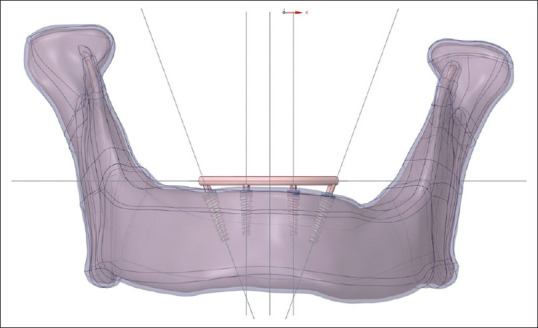
3D model with all-on-four concept. 3D – Three-dimensional
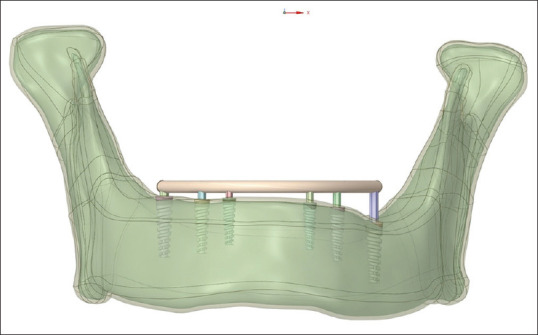
3D model with all-on-six concept. 3D – Three-dimensional
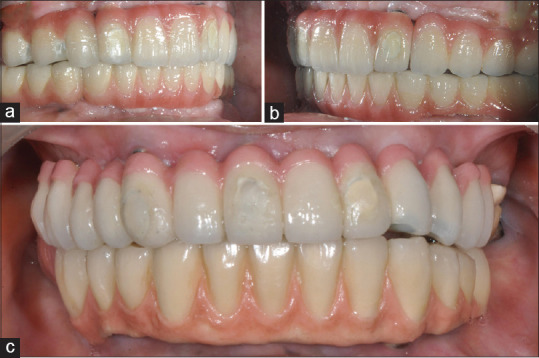
(a) Right lateral view, (b) Left lateral view, (c) Frontal view
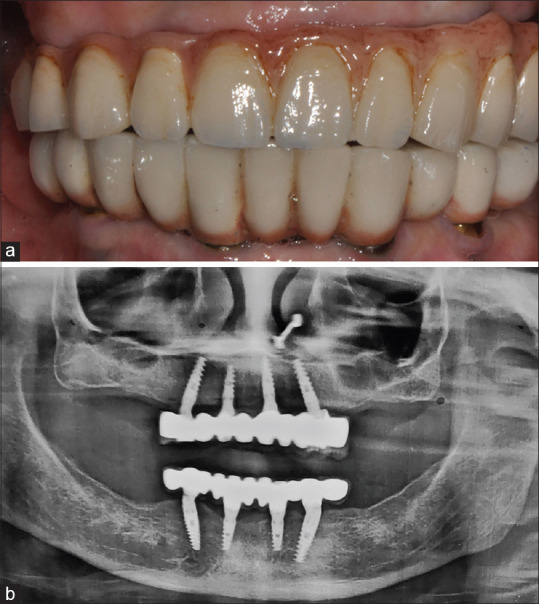
All-on-four (a) Frontal intra-oral view (b) Orthopantomogram
For additional case Photos, please see the Full Case Report (PMC10159094)
Conclusion: It could be inferred from the findings obtained in our study that the all-on-six treatment concept (Model B) which showed better biomechanical behavior could be considered a viable alternative for long-standing edentulous mandible rehabilitation. The additional number of implants in the six-implant model increased the prosthesis support and experienced reduced maximum principal stress with better distribution of stress over a larger region. The results of our study suggest that particularly in the cases of biomechanical risk (e.g., bruxism, low-quality bone), larger number of implants may be required for better stress distribution and in atrophic ridges, “All-on-Four” design could be a good alternative. [5].
Case 2: All-on-6 With Indirect Sinus Lift (Aggarwal et al., 2026)
A 33-year-old woman received six implants in the upper arch. An indirect (minimally invasive) sinus lift was done at one back site where bone height was about 8 mm. Because primary stability was moderate, the team chose delayed loading and waited five months before placing multi-unit abutments (0°, 17° and 30°) to align the implants. A splinted open-tray impression and a digital design workflow were used to make a screw-retained porcelain-fused-to-metal prosthesis, tightened to 35 Ncm [6].
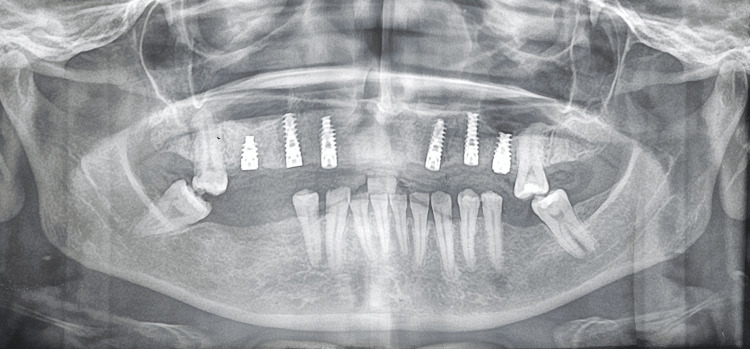
OPG after implant placement.
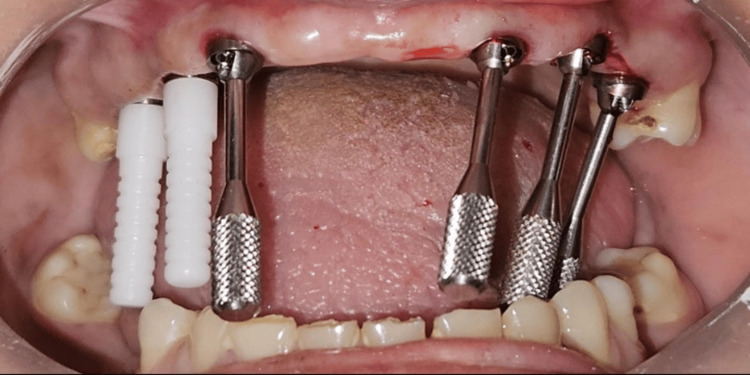
Intraoral view showing the placement of the six multi-unit abutments.
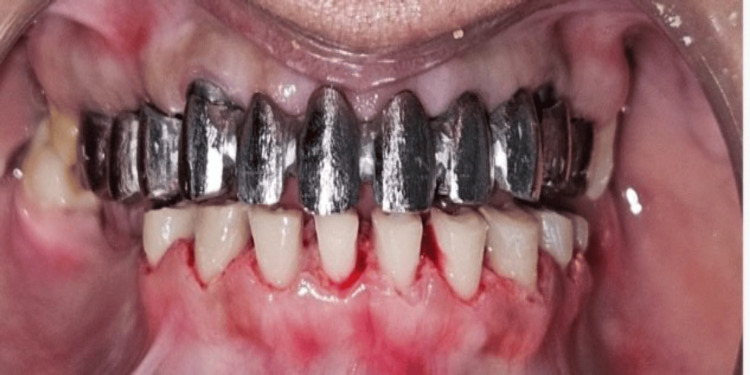
Metal try-in .
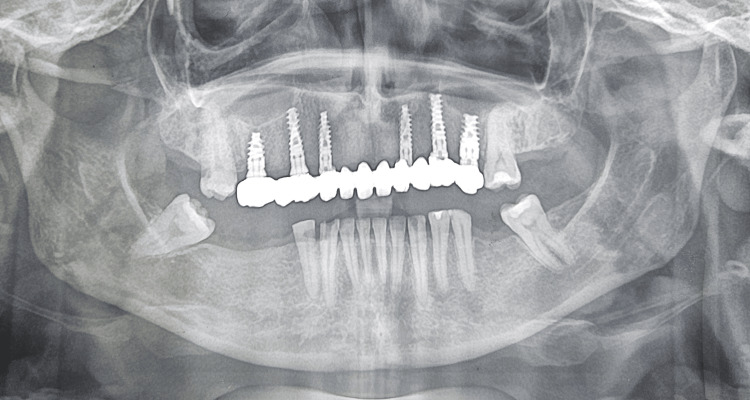
Postoperative OPG evaluating the final positioning of the implants and prosthesis.
For additional case Photos, please see the Full Case Report
Conclusion: With careful CBCT-based planning, accurate surgery, angulation correction and a structured prosthetic workflow, the All-on-6 approach gave a predictable functional and esthetic result, with long-term maintenance remaining essential [6].
Conclusion
All-on-4 has an impressive track record, including data beyond 20 years. All-on-6 is not a replacement for it, but an additional tool that may be the better fit for patients with higher biomechanical demands or in the upper jaw. The newest research is encouraging for six-implant upper-jaw treatment, and it reminds us that lasting success depends on careful planning and regular maintenance visits.
References
- Maló P, Rangert B, Nobre M. “All-on-Four” immediate-function concept with Brånemark System implants for completely edentulous mandibles: a retrospective clinical study. Clin Implant Dent Relat Res. 2003;5 Suppl 1:2-9.
- de Araújo Nobre M, Lopes A, Ferro A, Nunes M, Gouveia M, Santos D, Moura Guedes C, Almeida R, Antunes C. Immediate full-arch mandibular rehabilitation supported by four implants: A retrospective study with 20 to 25 years of follow-up. J Dent. 2026 Feb;165:106286.
- Zhang Y, Li S, Di P, Zhang Y, Wu A, Lin Y. Comparison of 4- or 6-implant supported immediate full-arch fixed prostheses: A retrospective cohort study of 217 patients followed up for 3-13 years. Clin Implant Dent Relat Res. 2023 Apr;25(2):381-397.
- Pandey A, Durrani F, Rai SK, Singh NK, Singh P, Verma R, Kumar J. (Introduction, citing Brånemark’s original four- to six-implant protocol and the rationale for tilted implants; see reference 5.)
- Pandey A, Durrani F, Rai SK, Singh NK, Singh P, Verma R, Kumar J. Comparison between all-on-four and all-on-six treatment concepts on stress distribution for full-mouth rehabilitation using three-dimensional finite element analysis: A biomechanical study. J Indian Soc Periodontol. 2023 Mar-Apr;27(2):180-188. Full text (PMC10159094)
- Aggarwal S, Jindal T, Sachdeva S. All-on-Six Implant-Supported Full-Arch Maxillary Rehabilitation With Indirect Sinus Elevation and Multi-unit Abutment Conversion: A Case Report. Cureus. 2026 Apr 10;18(4):e106800. Full text (PMC13157877)
- Qu Y, Yang C, Wu W, Lu H, He F. Maxillary Rehabilitation With All-On-6 and Bilateral Lateral Window Sinus Elevation: 1-10-Year Outcomes. Clin Implant Dent Relat Res. 2026 Oct;28(5).